
How to Check Blind Spots the Right Way
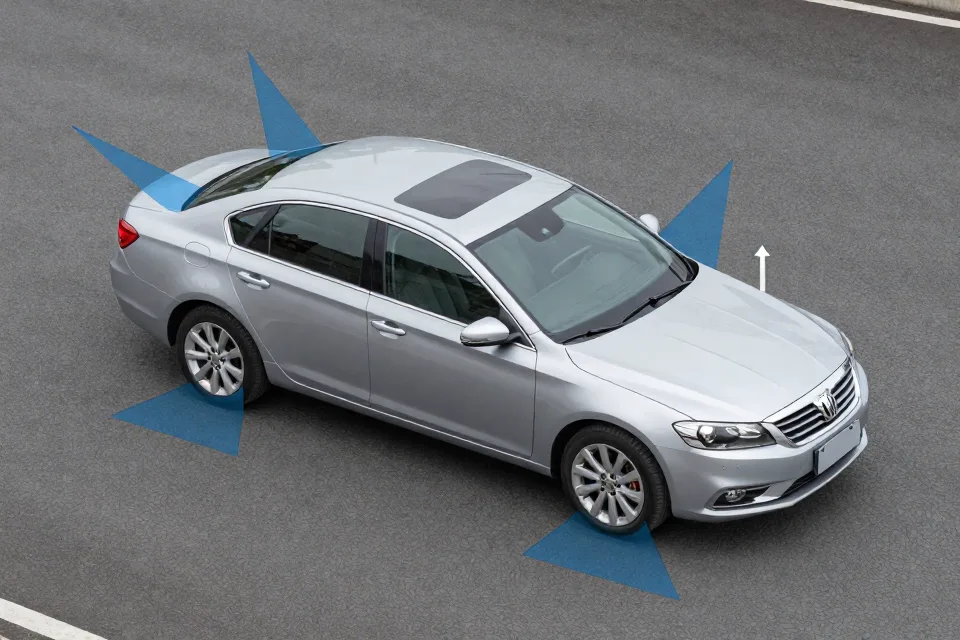
Every driver knows the moment: you check your mirrors, the lane beside you looks empty, and you start to ease over, then a horn blares. A car you never saw was sitting a few feet from your door, in the one zone your mirrors cannot show you. That zone is your blind spot, and the surprise it causes is almost always avoidable.
Blind spots are not a flaw you have to live with. They are a geometry problem, and geometry has an answer: set your mirrors correctly, build one quick habit, and know what your car's sensors can and cannot catch. Here is the whole system, step by step, in plain English.
What a Blind Spot Actually Is
Put simply, a blind spot is any zone around your car that stays hidden from your windshield and mirrors. The National Safety Council explains them as the areas a driver cannot easily see, usually the narrow strips of road beside and slightly behind the vehicle.
Why do they exist? Mirrors have limits. Your inside mirror shows what is directly behind you, and each side mirror covers a slice of the lane beside you. Between those slices, near the rear corners of your car, sits a gap. A car or motorcycle in that gap is invisible to every mirror on your vehicle.
Blind spots also differ from vehicle to vehicle. A low sedan hides different things than a tall pickup, and your seating height changes what you can see. No mirror setting erases blind spots entirely; good settings only shrink them. That is why the final check is you, turning your head.
Why This Matters More Than Ever
Blind-zone crashes are not a rare event. NHTSA analysis puts blind zone and lane-change related crashes at about half a million a year in the United States, roughly 8.7 percent of the crash population it studied, with about 540 of those crashes ending in a fatality.
The problem has grown as vehicles have changed. IIHS research found that for three popular SUVs, forward visibility within about 33 feet (10 meters) of the vehicle fell as much as 58 percent across redesigns from 1997 to 2023. A 1997 Honda CR-V let its driver see 68 percent of the area in front of the vehicle; the 2022 model showed only 28 percent. That 33-foot distance matters because it is roughly the stopping distance an average driver needs from 10 mph, exactly the low-speed zone where front blind spots cause crashes.
The left side of the vehicle is just as affected. In IIHS measurements, for a driver of average height (5-foot-9), the blind zone on the driver's side covered roughly a quarter of the space to the left and ahead of the car; for a 4-foot-11 driver it covered about a third. Taller hoods, thicker pillars, and bigger mirrors all chip away at what you can see.
Step One: Set Your Mirrors the Right Way
Most cars leave the showroom with side mirrors angled to show the driver's own doors. That feels familiar, but it wastes mirror area on road you have already passed. The American Automobile Association's method for a wide view is simple:
-
Sit in your normal driving position first. Mirrors set from any other position will be wrong when you drive.
-
Driver's side: lean your head left toward the window and angle the mirror outward until your car's side appears only as a thin sliver at the inner edge.
-
Passenger side: lean toward the center of the car, roughly over the center console, and aim that mirror the same way.
-
Sit back up. Each side mirror should now show the adjacent lane, with your own car barely visible at the inner edge.
The National Safety Council calls correctly aimed mirrors the first step to beating blind spots, and the same lean-and-adjust routine is what driver education programs teach. It does not eliminate blind spots, but it shrinks them dramatically. Take two minutes in a parking lot to set it up once, and you are set for every trip after.
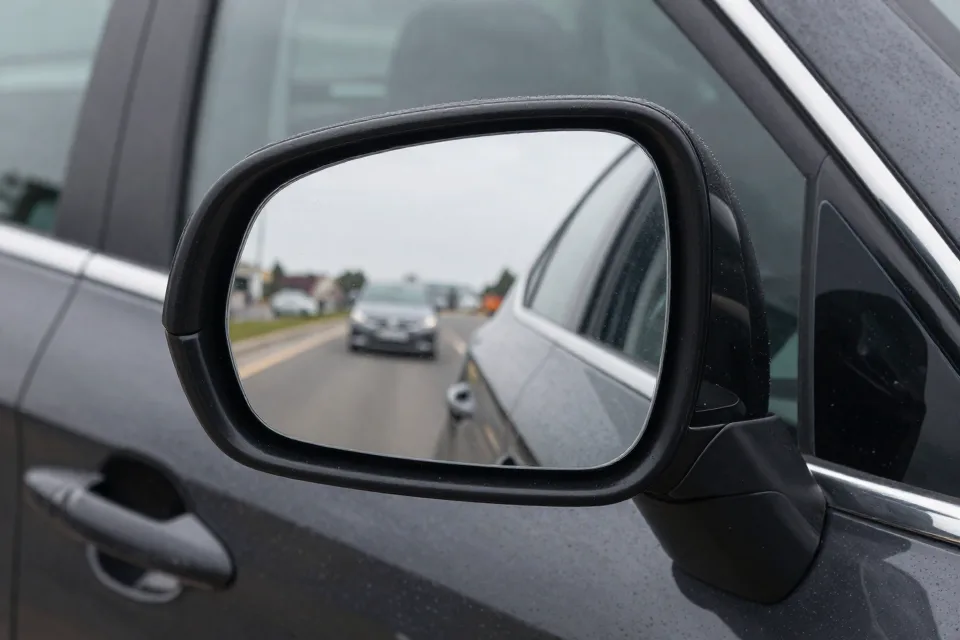
Step Two: Build the Three-Step Look
With mirrors set, the habit comes next. Before you merge, change lanes, turn, or pull away from a curb, run the same three steps in the same order:
-
Check your mirrors — inside mirror first, then the side mirror on the side you are moving toward.
-
Signal — let other drivers know what you are about to do, and give them a moment to react.
-
Shoulder check — turn your head and glance over your shoulder into the blind spot. A second look in the mirror is not the same thing; only your own eyes can see the zone the mirror cannot reach.
The National Safety Council's guidance for new drivers is straightforward: look in your mirrors and turn your head for a shoulder check every time you merge, turn, or switch lanes. Done smoothly, the whole sequence takes about a second or two, a quick glance rather than a long stare away from the road ahead.
Do the same before backing up. The rear corners are blind too, and a quick over-the-shoulder look combined with your mirrors catches what cameras and sensors can miss.
What Blind Spot Monitors Can and Can't Do
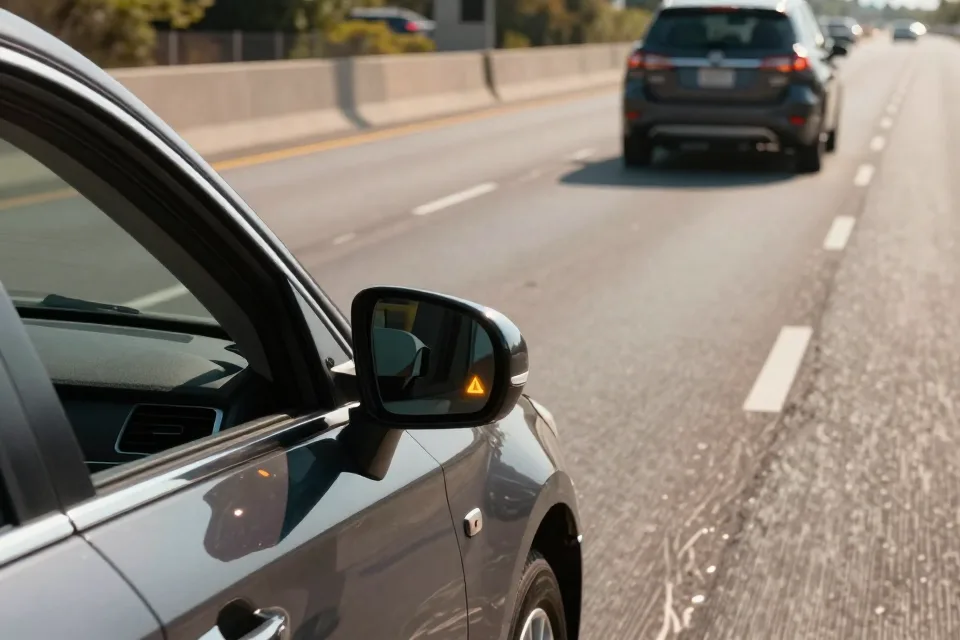
If your car has a blind spot warning system, use it, but do not treat it as a substitute for looking. NHTSA describes these systems as audio or visual alerts when a vehicle sits in an adjacent lane you may not see. The more advanced blind spot intervention systems can even apply light braking or gentle steering input if you start moving into an occupied lane.
The technology genuinely helps. IIHS research found that vehicles with blind spot monitoring were involved in 14 percent fewer police-reported lane-change crashes than vehicles without it.
But the systems have known gaps. AAA's testing found that blind spot monitoring struggled to detect fast-moving vehicles, exactly the situation you face merging onto a busy highway. Motorcycles took about 26 percent longer than cars to be picked up by the sensors, and dirt, snow, or heavy rain can confuse them.
The practical rule: the light in your mirror is a backup, not an all-clear. On a busy or wet highway, treat a warning as a reminder to check again with your own eyes.
Know the Blind Spots Around Big Trucks
Your blind spot is one thing; a semi's is another. The Federal Motor Carrier Safety Administration warns drivers not to linger in a large truck's or bus's blind zones, which run ahead of the vehicle, behind it, and along both sides of the trailer.
There is an easy test: if the driver's face is not visible in the truck's mirror, that driver cannot see you. And a loaded truck needs far more room to stop than your car, FMCSA notes that a big truck or bus can require stopping distance equal to two football fields. Pass them quickly and cleanly, and never settle in beside a trailer.
Common Mistakes Drivers Make
Even experienced drivers slip up. Here are the six most common blind-spot mistakes and how to break them:
-
Trusting mirrors alone. Mirrors leave a gap by design. Only the shoulder check covers it.
-
Pointing side mirrors at your own car. If you see a wide strip of your door, you are looking at road you already passed.
-
Skipping the right-side shoulder check. It is the easiest one to skip, and the side where a car in the next lane or a cyclist is hardest to spot.
-
Treating the warning light as all-clear. Fast vehicles and motorcycles can slip past sensors. Glance anyway.
-
Checking once, then hesitating. If you signal and wait, re-check before you move. Traffic changes in seconds.
-
Forgetting the blind zone in front. Tall hoods hide children, pets, and curbs. Ease forward slowly in parking lots and at stop signs, and look well past the hood.
Your Before-You-Drive Checklist
Five items, thirty seconds, every trip:
-
Set your seat first, then set your mirrors from that position.
-
Each side mirror should show the next lane with only a sliver of your own car.
-
Before every merge or lane change: mirrors, signal, shoulder check.
-
Use blind spot warnings as a reminder, never as a substitute.
-
Around trucks: if you cannot see the driver's face, they cannot see you. Do not linger.
Blind spots are one part of driving that is completely within your control. Set the mirrors once, practice the look until it is automatic, and the empty-lane surprise becomes a thing of the past.
This article is for general information only and is not a substitute for your state's driver manual or hands-on instruction in your own vehicle. For more details, see our disclaimer.

Sources
- [authority] https://crashstats.nhtsa.dot.gov/Api/Public/ViewPublication/812653