
Deer on the Road: How to Avoid a Collision
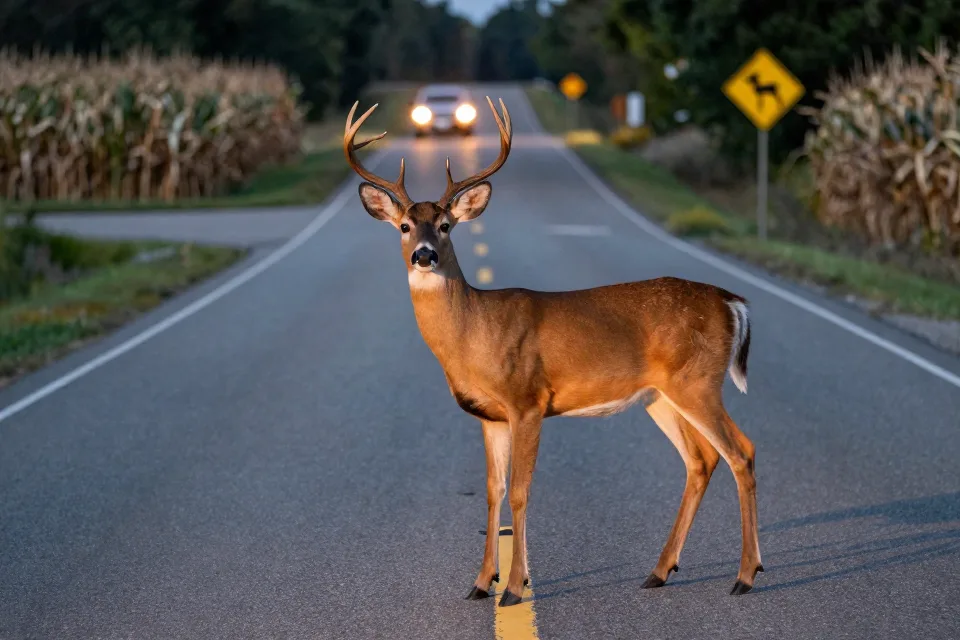
It happens in a heartbeat. One moment the road ahead is empty; the next, a deer is standing in your lane, caught in the glare of your headlights. There is no time to think, only time to react.
Every year, American drivers file well over a million insurance claims after hitting an animal, and deer are the animal most often struck. The good news: most deer collisions are survivable, and most are avoidable. The habits in this article take seconds to learn and could save you a repair bill, a totaled car, or worse.
This guide covers when deer are most likely to cross your path, how to drive in deer country, what to do in that split-second moment, and what to do after a strike. It is written for everyday drivers — the commute home at dusk, the Sunday drive through the countryside, the holiday trip on two-lane roads.
Why a Deer Can Seem to Appear Out of Nowhere
Deer do not understand that a road is dangerous. To a deer, a highway is just an open clearing on a familiar trail between where it feeds and where it beds down for the night. That is why deer crossings happen in the same stretches year after year — and why local authorities post yellow warning signs where deer habitually cross.
Timing matters as much as location. Deer are most active around dawn and dusk, when they move between feeding and resting areas. Consumer Reports pegs the busiest window at dawn and roughly 6 p.m. to 9 p.m. — exactly when many of us are commuting, and exactly when fall's shorter days leave the road dark.
Add the breeding season, and you have the recipe for the worst stretch of the driving year. Deer mate in the fall, and the rut sends bucks roaming far beyond their usual territory. Collisions spike from October through December, and November is the single most dangerous month for animal collisions, according to State Farm.
One more thing to remember: deer rarely travel alone. Where there is one, more are usually close behind. A doe and her fawns, or a small buck group, can string across the road one after another. If you see one deer cross safely, do not relax — the hardest part may still be coming.
The Numbers Behind Deer Season
State Farm estimates that U.S. drivers filed more than 1.7 million animal-collision insurance claims between July 2024 and June 2025. On average, an American driver has about a 1 in 139 chance of hitting an animal in a given year. The risk is not spread evenly: West Virginia drivers face the highest odds in the country, while Pennsylvania records the most claims of any state.
Deer are the animal most often struck, according to the Insurance Information Institute. In 2017, an estimated 350,000 police-reported crashes in the United States involved deer or other large animals, resulting in about 42,000 injuries and roughly 300 deaths, per the AAA Foundation for Traffic Safety, which analyzed federal crash data. Because only police-reported crashes are counted, the true total is certainly higher.
The toll can be fatal even when it does not look like a high-speed crash. The Insurance Institute for Highway Safety counted 164 deaths in collisions with animals in 2021, with most occurring between October and December. Over a longer window, AAA tallied more than 2,080 fatal crashes involving animals from 2001 to 2011.
Financially, the season is brutal on cars. Carfax calls autumn the most dangerous season for auto accident damage in the United States, and a deer strike is one of the fastest ways to total a vehicle — one video shared by The Drive shows a deer strike instantly destroying a Dodge Charger. Even a glancing hit can smash a headlight, crumple a hood, and push a radiator into the engine.
Drive Defensively in Deer Country
The best deer strategy is simple: slow down where deer live, and look for them before they are in your lane. Speed is your enemy, because a deer can go from roadside to roadway faster than you can blink. On two-lane roads bordered by woods or fields, ease off the gas at dawn and dusk.
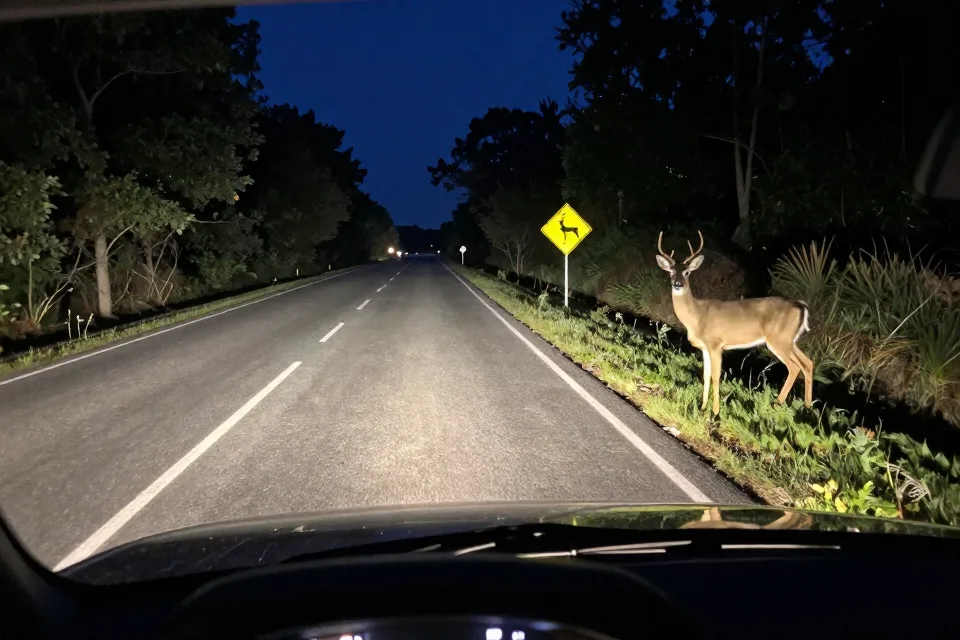
Scan the edges of the road, not just the center line. Deer are hard to see in brush, but their bodies, their movement, and — at night — the reflective glow of their eyes give them away. AAA advises using high beams whenever there is no oncoming traffic, because the extra light reaches farther and catches those reflective eyes sooner.
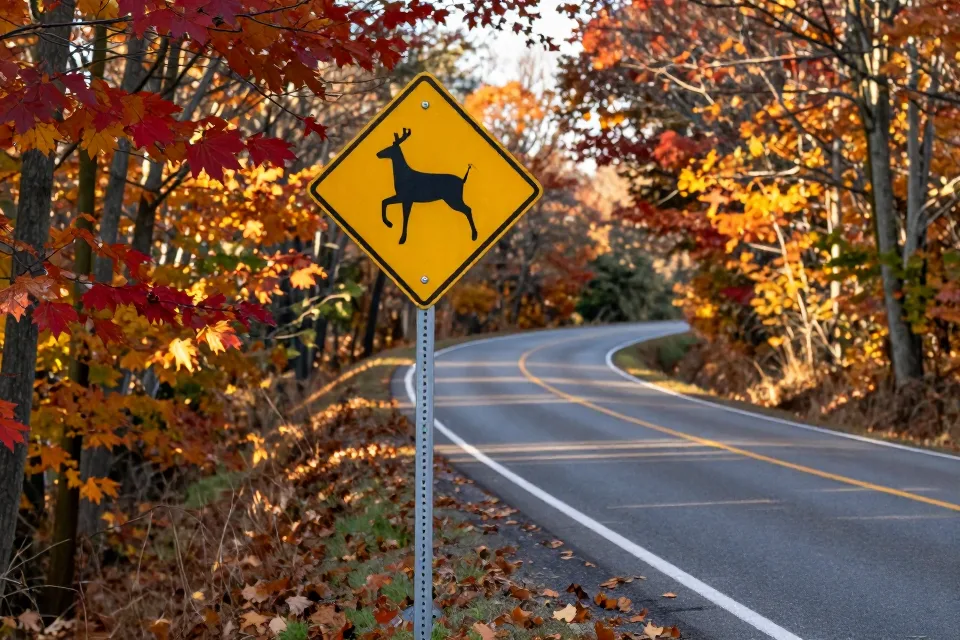
Heed the warning signs. A yellow deer-crossing sign is not decoration; it marks a stretch where deer are known to cross. Treat it like a school zone: reduce speed and stay ready. It also pays to watch the brake lights of the car ahead — if the driver in front of you brakes suddenly in deer country at dusk, there may be a deer they can see and you cannot.
One popular gadget is not worth the money. Car-mounted deer whistles, the small plastic devices sold to scare deer away with sound, have no scientific evidence behind them, State Farm notes. Save the money and spend it on a clean windshield and well-aimed headlights instead.
When a Deer Is Right in Front of You
This is the moment every driver dreads. The correct response sounds wrong to many people: brake firmly and stay in your lane. Do not swerve. Swerving to miss a deer often causes a worse crash — a head-on with oncoming traffic, a rollover on the shoulder, or a tree at full speed. AAA, Consumer Reports, state police, and state transportation departments all give the same advice.
If you have time, honk your horn in long, loud blasts. The sound can startle the deer into moving off the road. But do not count on it, and do not let honking replace braking.
If a crash becomes unavoidable, hold the wheel with both hands, keep your foot on the brake, and brace. Hitting the deer while slowing in a straight line gives you the best chance of staying in control and keeping the impact low. Keep your seat belt on — it is your single best protection in any impact.
And remember the group rule: even after one deer passes, expect a second. Keep your foot ready over the brake until you are well past the crossing area.
Common Mistakes Drivers Make
These are the errors that turn a close call into a crash:
| Mistake | Why It Hurts | What to Do Instead |
| --- | --- | --- |
| Swerving at the last second | Can cause a head-on crash, rollover, or tree strike | Brake firmly and hold your lane |
| Speeding through dusk on rural roads | Leaves no time to react to a deer | Slow down at dawn and dusk in wooded areas |
| Staring at the deer instead of the road | You tend to steer where you look | Keep your eyes on your escape path |
| Relaxing after one deer crosses | Deer travel in groups; more are often behind | Expect a second deer and stay ready to brake |
| Trusting a deer whistle | No scientific evidence they work | Rely on speed, lights, and attention |
| Keeping high beams off even on empty roads | Cuts how far you can see at night | Use high beams when no traffic is coming |
| Assuming deer stay out of towns | Deer wander into suburbs and neighborhoods too | Stay alert in city-edge areas in the fall |
| Approaching an injured deer | A frightened, hurt deer can kick or gore you | Call police or animal control, keep your distance |
If the Worst Happens: After a Deer Strike
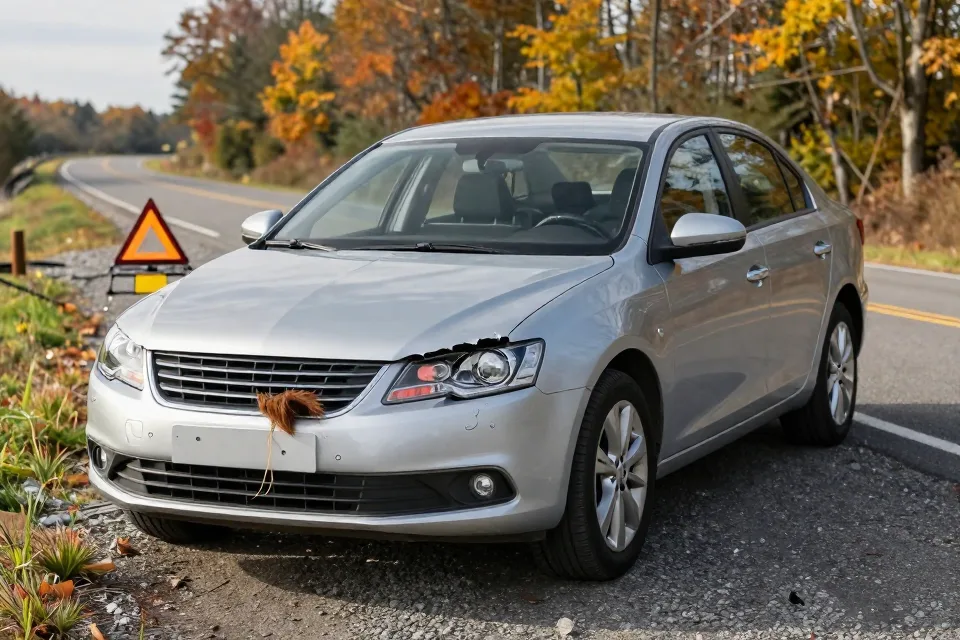
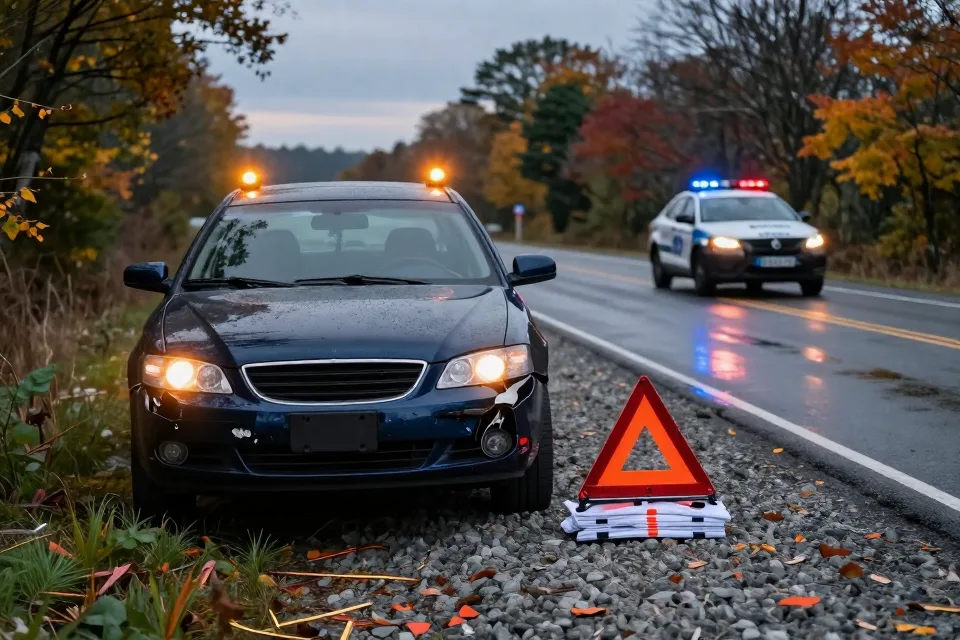
If you hit a deer, your first job is to get yourself to safety. Steer to the shoulder or a nearby safe spot, turn on your hazard lights, and stay inside the car while you collect yourself. Then call the police or animal control — both to report the crash and to have the deer removed if it is lying in or near the road, where it becomes a danger to other drivers.
Do not approach the deer, no matter how still it lies. An injured deer is unpredictable and can deliver a serious kick with its front legs. Leave handling the animal to trained officers or wildlife professionals.
Photograph the scene and the damage from a safe distance, then call your insurance company when you get home. Repair costs from hitting a deer are typically paid under comprehensive coverage, according to Consumer Reports — the same coverage that pays for theft, hail, and falling branches. If your car is not drivable, arrange a tow, and if you are unsure about local reporting rules, ask the responding officer.
Your Deer-Season Checklist
Before you head out in deer season, run through this list:
-
Slow down at dawn and dusk, especially on two-lane roads with woods or fields alongside
-
Scan the roadside edges and watch for reflective eyes at night
-
Use high beams whenever no oncoming traffic is present
-
Treat deer-crossing warning signs like school zones
-
If a deer appears: brake firmly, hold your lane, honk in long blasts
-
Expect a second deer after the first one crosses
-
Keep your seat belt on at all times
-
After a strike: reach a safe spot, call police or animal control, never touch the deer, photograph the damage, and call your insurer
A deer can appear out of nowhere, but your response does not have to be a gamble. Slow down, look ahead, and brake — not swerve — and you give yourself the best odds on the road. That is a small habit that can save your car, your wallet, and your life.
The information in this article is general safety guidance, not professional advice about your specific vehicle, insurance policy, or legal situation. For more on how we handle content on this site, see our disclaimer.
Sources
- [authority] https://crashstats.nhtsa.dot.gov