
Driving in Heavy Rain: What Really Keeps You Safe
Why Rain Is Harder on You Than It Looks
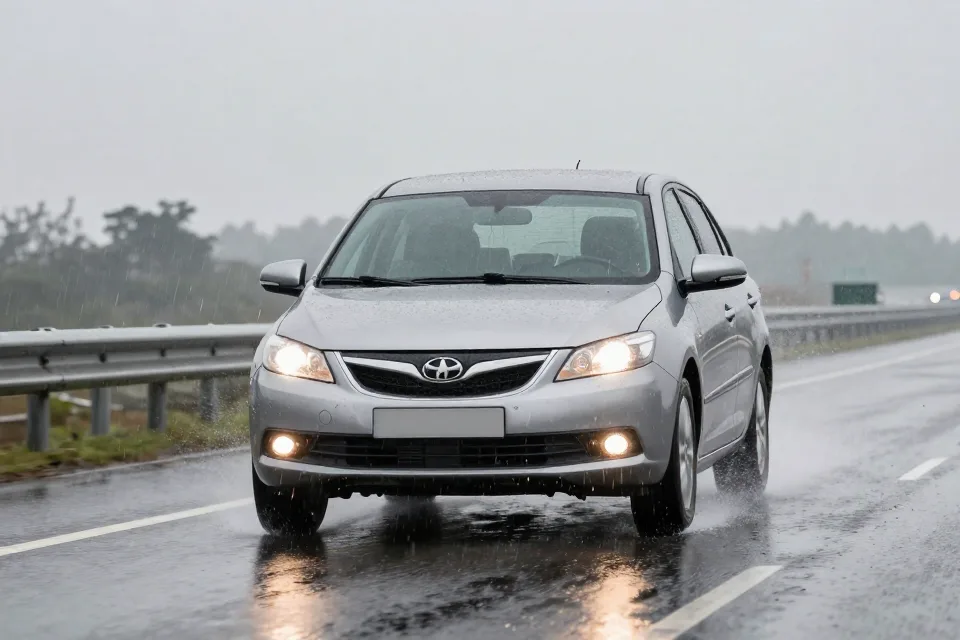
A light sprinkle feels harmless, but a hard downpour changes everything about how your car grips and stops. Wet pavement shows up in a striking share of every weather-related crash on U.S. roads. For drivers over 50, the real risks are not speed or skill. They are slick tires, poor visibility, and the sneaky danger of hydroplaning.
The good news is that nearly every rain-related wreck is avoidable. A few habits you can start today, plus a couple of quick checks on your own car, make a real difference. Here is what actually keeps you safe, step by step.
Know Your Real Risk
Rain is a much bigger factor than many drivers think. According to the Federal Highway Administration, about 75 percent of weather-related crashes happen on wet pavement, and roughly 47 percent occur during rainfall. Over the past few years, weather-related crashes killed more than 3,800 people and injured over 268,000 each year on average.
Those numbers do not mean you should stay home every time it clouds over. They do mean wet roads deserve more respect. Most of these crashes come from simple, everyday mistakes that are easy to fix once you know them.
Slow Down More Than You Think You Need To
Speed limits are written for dry roads and clear skies. In rain, they no longer apply to what your car can safely do. Wet pavement stretches your stopping distance by a lot, and your tires need more time to push water out from under them.
When you go slower, your tires get that extra moment to grab the road, and you get more time to react. Slowing down is the single most reliable way to keep your car from hydroplaning. If the rain is heavy, ease off the gas well before you reach a stop sign or a turn.
Let Your Tires Do Their Job
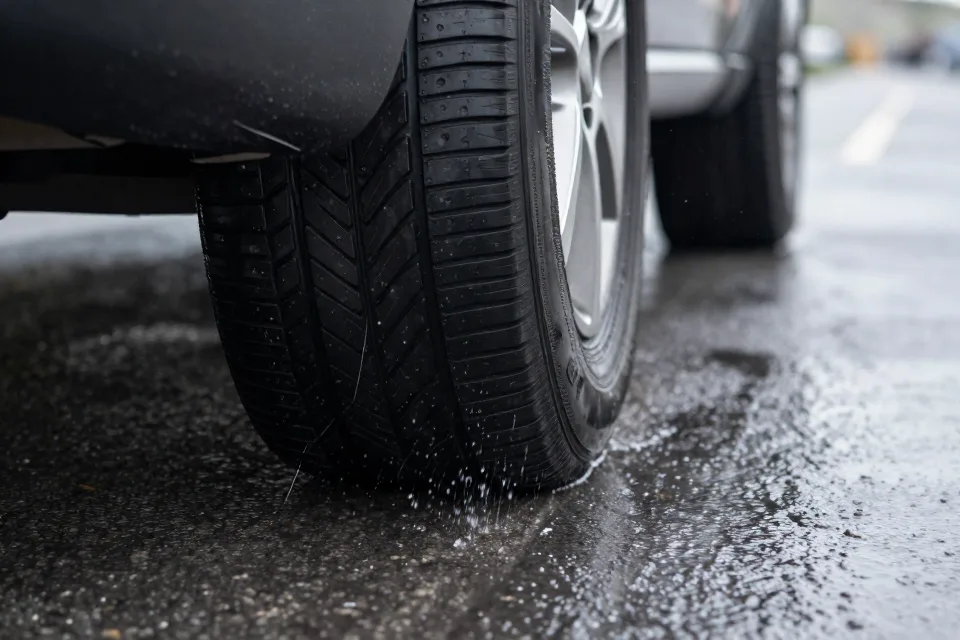
Your tires are what keep you connected to the road in the wet. The grooves in the tread are not decoration. They are little channels that squeeze water out from under the tire so the rubber can still touch the pavement.
When tread wears down, those channels get shallow and stop working. The legal minimum tread depth in the United States is two thirty-seconds of an inch (2/32 in), but safety experts agree that is far too low for wet weather. It is better to replace tires around 4/32 inch of tread, especially if you drive often in rain.
You can check this yourself in under a minute with a penny. Place it in a tread groove with Abraham Lincoln's head pointing down. If the top of his head is still visible above the tread, you are close to or below 2/32 inch and the tire needs to go. For wet roads, try the same trick with a quarter and George Washington's head. If you can see all of it, tread is around or below 4/32 inch, and it is time to plan for new tires.
What Hydroplaning Feels Like (and What To Do)
Hydroplaning happens when your tires ride up on a thin film of water and lose their grip on the road. It can start at surprisingly low speeds. Even near-new tires can begin to lift at speeds as low as 35 miles per hour when the road is wet. With as little as one-twelfth of an inch of water on the pavement, a tire has to push aside about a gallon of water every second to keep touching the road.
The feeling is distinct: the steering suddenly feels light, and the car seems to float or drift. When that happens, your instincts can make it worse. The safe response is the opposite of a panic reaction.
If you feel the car starting to hydroplane, do these three things in order:
-
Take your foot gently off the gas. Do not slam the brakes.
-
Hold the steering wheel steady and aim where you want to go. Avoid sharp turns.
-
Wait for the tires to grab again before you brake or steer harder.
Braking hard mid-skid can throw the car off balance. Easing off the gas lets the tires slow naturally and re-find the road.
Turn Off the Cruise Control
It is tempting to keep cruise control on in a steady rain, but that is one of the most common mistakes on wet roads. If your car hydroplanes while cruise control is active, the system may try to hold your set speed and actually speed the car up as the wheels lose grip.
Cruise control also keeps your foot off the pedal, which makes you slower to react. For wet weather, drive with your foot doing the work. It keeps you alert and ready to ease off at the first sign of a slide.
See Clearly and Be Seen
Half of staying safe in rain is seeing well, and the other half is making sure other drivers can see you. Both are cheap to fix.
Turn on your headlights any time it is raining, even in daylight. It is the law in many states, and it makes your car far easier to spot through a rain-spotted windshield. Check that your taillights, brake lights, and turn signals all work too.
Windshield wipers are easy to forget until you need them. Replace the blades if they smear, skip, or leave streaks instead of clearing the glass in one swipe. A foggy windshield is a common companion to rain. Use your defroster or crack a window to move the air and keep the glass from fogging up.
Leave Room and Brake Gently
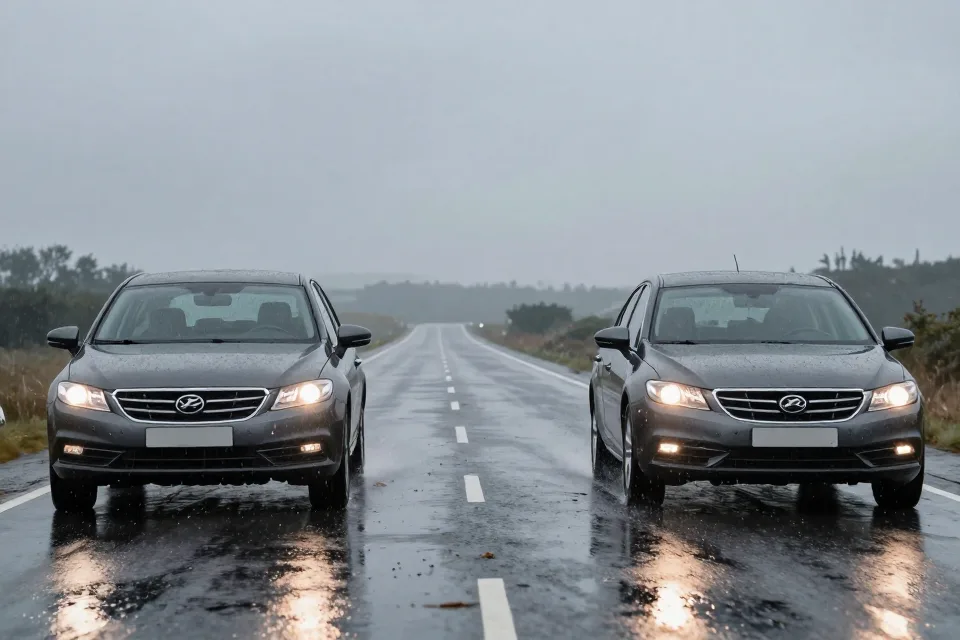
Wet roads roughly double how long it takes to stop compared to dry roads. The usual two- or three-second following gap is not enough in rain. A good rule is to double your following distance, aiming for a gap of at least four seconds between you and the car ahead.
Braking itself needs more care too. Start slowing earlier and use less force than you would on a dry road. Sudden, hard braking on wet pavement is a fast route to a skid, and it can also surprise the driver behind you into a rear-end crash.
Never Drive Through Standing Water
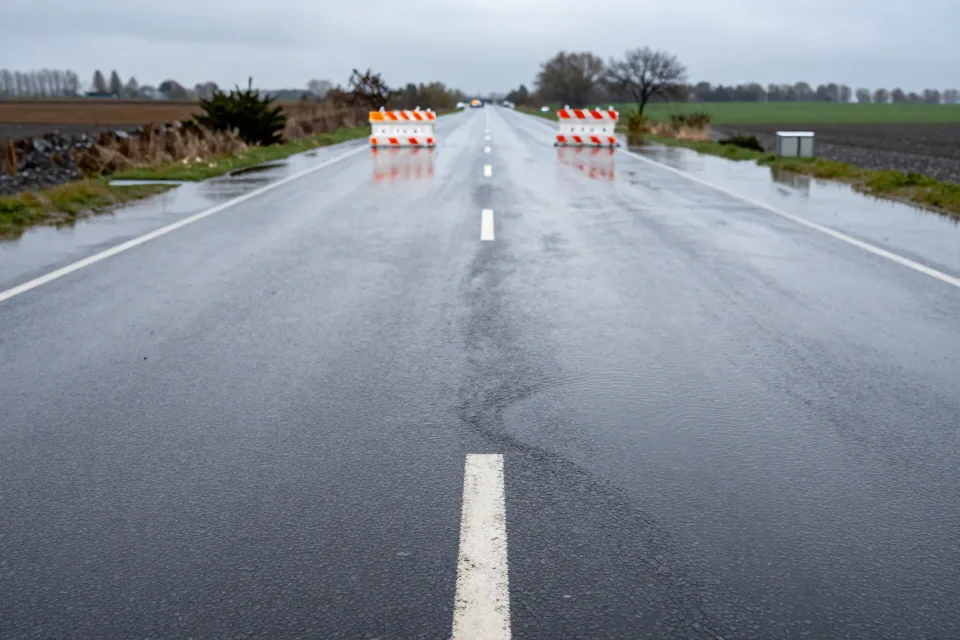
This is the one rule that can save your life, and it is the easiest to forget in the moment. If you see water covering the road, do not guess how deep it is. Turn around and find another way. The National Weather Service phrase for this is Turn Around, Don't Drown.
It takes very little moving water to pick up a car. Just a few inches of rushing water can sweep a vehicle off the road, and even a stalled car in flood water can trap you. More than half of all flood-related drownings happen when a vehicle is driven into flood water.
Never try to cross a road that is covered in water you cannot see to the bottom of. Even a familiar street can hide a washed-out section or a risen stream underneath.
Common Mistakes That Make Rain Driving Risky
Most drivers make at least one of these without realizing it. A quick read can save you a very bad day.
-
Trusting cruise control. It can make a hydroplane worse and slows your reaction.
-
Waiting too long on worn tires. A tire is not "fine" just because it passes a quick look. Wet roads need deeper tread.
-
Braking hard or yanking the wheel. Sharp inputs are exactly what a slick road punishes.
-
Driving into standing water. No errand is worth being swept away or stranded.
-
Skipping lights and wipers. You cannot drive safely if you cannot see, or be seen.
-
Following too close. A two-second gap on wet pavement gives you almost no room to stop.
Your Rain-Day Checklist
Before your next rainy drive, run through this quick list. It takes minutes and covers almost everything.
-
Slow down before you think you need to.
-
Turn off cruise control and keep your foot active.
-
Turn on your headlights, even in daylight.
-
Double your following distance to at least four seconds.
-
Check your wiper blades clear the glass in one swipe.
-
Do the penny or quarter test on your tires today.
-
If water covers the road, turn around and choose another route.
Heavy rain is dangerous mostly because it is underestimated. Give yourself speed, space, clear glass, and good tires, and you have already removed most of the risk. Stay sharp, and you will arrive dry and safe.
This article is for general information only and is not a substitute for professional driving instruction or advice for your specific vehicle. Always follow local laws and road conditions. For more details, see our disclaimer.
Sources
- [authority] https://ops.fhwa.dot.gov/weather/roadimpact.htm