
What an OBD2 Scanner Tells You About Your Car
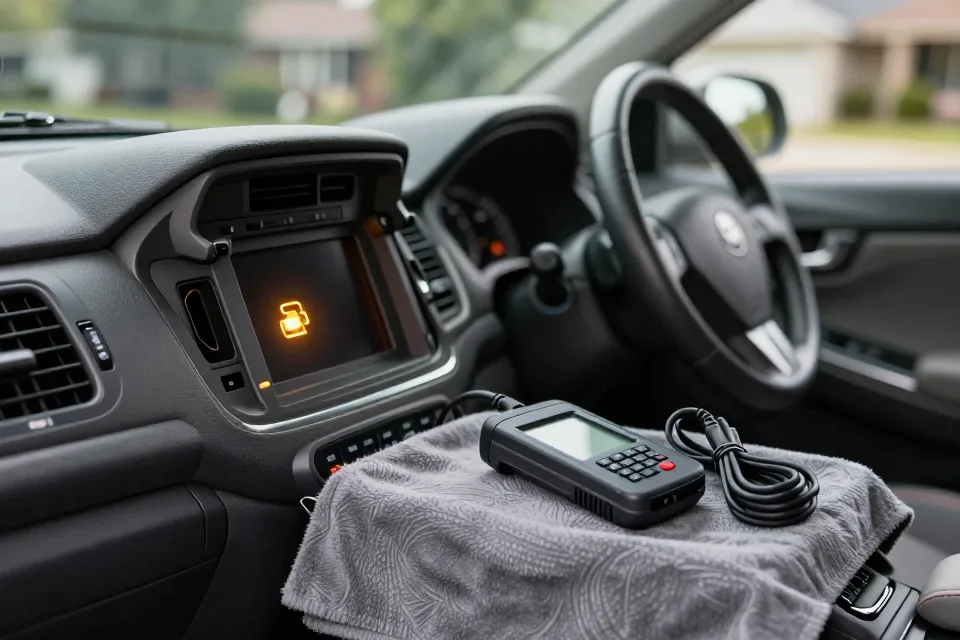
That Little Light, Decoded
A small amber icon shaped like an engine glows on your dashboard, and your mind races through the worst-case scenarios. Is it the gas cap, or a repair that costs as much as a vacation? Here is the reassuring truth: your car already knows the answer. Every car built since 1996 carries a computer that watches over the engine and records what it finds. An OBD2 scanner is simply the tool that lets you read those notes.
If you have never touched a scan tool, you are in good company. CarMD, a company that tracks check-engine repair data, reports that nearly half of drivers have at least one dashboard warning light on. Yet most of those warnings are easy to investigate once you understand a few basics. By the end of this guide, you will know how to plug in a scanner, make sense of the code it shows, and talk to a repair shop with confidence.
What an OBD2 Scanner Actually Does
OBD stands for on-board diagnostics. Since the 1996 model year, the U.S. Environmental Protection Agency has required passenger cars and light trucks to carry a standardized OBD-II system that keeps an eye on the engine and its emissions controls. California regulators led the push for the standard, and the federal rules followed.
The system runs constant self-checks. When something falls outside expected ranges, the computer stores a diagnostic trouble code, or DTC, and lights the dashboard warning that engineers call the malfunction indicator light. That is your check engine light.
A scanner plugs into the car's diagnostic port and reads those stored codes, along with supporting data. Think of it as a translator between you and the car. One caution is worth keeping in mind: a code tells you which system reported a problem and under what conditions. It is a starting point for diagnosis, not a verdict. A good technician treats the code as one clue among many.
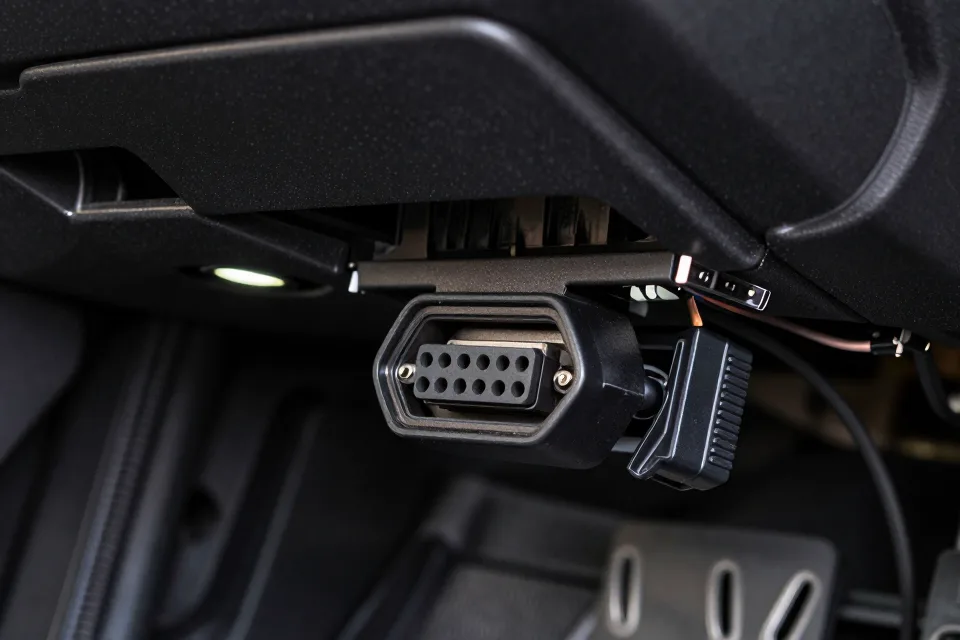
Finding the Port: Under the Dash
The port is standardized, which is why one scanner works on nearly any car. Vehicles sold in the U.S. since 1996 share the same 16-pin connector, defined by the SAE J1962 standard. In most cars and trucks it sits under the dashboard on the driver's side, within easy reach of the steering wheel. It may hide behind a small cover or near the fuse panel, but it is never far away.
Because the connector is universal, the scanner you buy for your sedan will also work on your spouse's pickup or your adult child's hatchback. That common design is the whole point of OBD-II: one port, one connector, one family of codes.
How to Read a Code: P, B, C, and U
Every standard code has five characters, and the first letter tells you which system is talking:
-
P — Powertrain: the engine, transmission, and emissions-related systems. Most check engine codes start with a P.
-
B — Body: airbags, climate control, and other comfort and safety systems.
-
C — Chassis: brakes, steering, and suspension electronics, such as the ABS.
-
U — Network: communication problems between the car's computers.
The third character narrows it down further. In powertrain codes, a 1 or 2 points to fuel or air metering problems, 3 to ignition issues, 4 to auxiliary emissions controls, 5 to idle control, 6 to computer or output circuits, and 7 or 8 to the transmission.
One more layer: automakers can add their own codes on top of the standard set. Basic scanners often read only the generic codes. If you need the deeper, manufacturer-specific ones, which can name a part directly, you may need a more capable tool or a shop's professional equipment.
Five Codes You're Most Likely to See
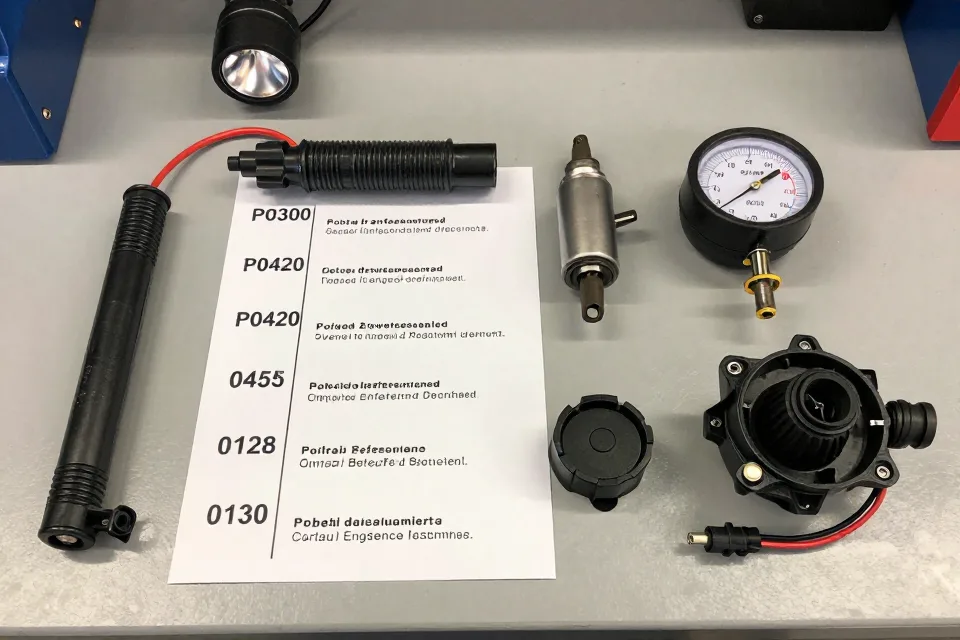
A handful of codes show up again and again. Here are five classics and what they usually mean:
| Code | What it usually means | What to expect |
|---|---|---|
| P0300 | Random engine misfire — cylinders are not firing consistently | Often spark plugs or ignition coils, sometimes a vacuum leak; the light may flash |
| P0420 | Catalyst system efficiency below threshold | The catalytic converter may be failing, but a bad oxygen sensor can set it too; the converter itself needs real testing |
| P0455 | EVAP system leak detected, large leak | Fuel vapors escaping, often from a loose or worn gas cap |
| P0128 | Coolant temperature below thermostat regulating temperature | Usually the thermostat |
| P0130 | Oxygen sensor circuit malfunction, bank 1 sensor 1 | Sensor replacement, sometimes a wiring problem |
Costs vary widely, but the pattern is useful. CarMD's annual index of real-world check-engine repairs found catalytic converter replacement to be the most common job, averaging about $1,300, with oxygen sensor replacement close behind at roughly $270. At the other end of the scale, a loose gas cap, which sits behind many EVAP codes, costs nothing to tighten and about $28 to replace. The car research site Edmunds notes that a faulty oxygen sensor is the leading cause of check-engine lights. The lesson: do not assume the worst until you know which code you are holding.
Freeze Frame and Live Data: The Story Behind the Code
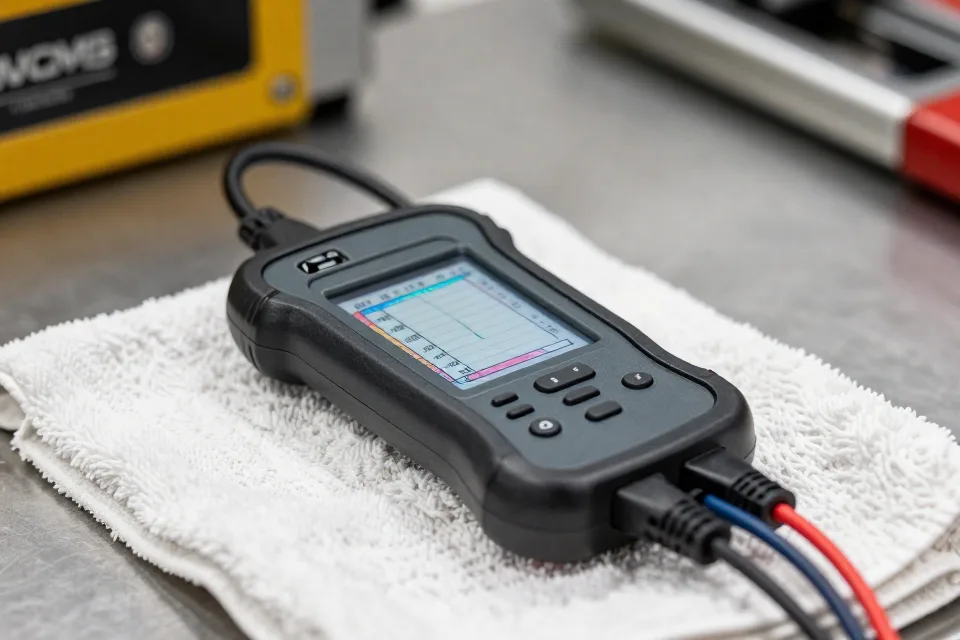
A basic reader hands you the code. A slightly better one hands you the story behind it. Freeze frame data is a snapshot of key readings — engine speed, coolant temperature, vehicle speed — captured at the instant the code was stored. If your light came on while climbing a long grade at highway speed, the freeze frame will often show it. That context helps a technician reproduce and pin down the problem.
Live data goes a step further. While the engine runs, a scanner can display real-time sensor values, such as oxygen sensor voltage and fuel trim readings. Watching these numbers change as you drive can expose a sensor that is failing but has not yet set a code. Better tools even graph the data so trends are easy to spot. None of this is required for the average driver — but it explains why a $25 reader and a $250 tool are not the same machine.
Readiness Monitors: The Hidden Report Card
Here is a feature most drivers never hear about: your car runs up to 11 self-tests, called readiness monitors, that check its emission controls while you drive. Think of them as the car grading its own homework. When a test finishes successfully, the monitor shows “Ready.” If it has not run yet, it shows “Not Ready.”
Why should you care? Because states that run emissions inspections rely on these monitors. In New York, for example, an OBD vehicle from model years 1996 through 2000 fails if more than two monitors are “Not Ready,” and 2001-and-newer models fail if more than one is “Not Ready.” California tightened the rule in October 2025: every readiness monitor must be set for a Smog Check to pass.
The practical point: when codes are cleared, or the battery is disconnected, the monitors reset to “Not Ready,” and the light may stay off even though nothing was fixed. Officials in Ohio and Colorado advise driving a few days, mixing city and highway miles, so the monitors can complete before an emissions retest. That is also why clearing a code to switch off the light before a test is a bad idea; the readiness data will tell the inspector the truth.
Steady Light or Flashing Light?
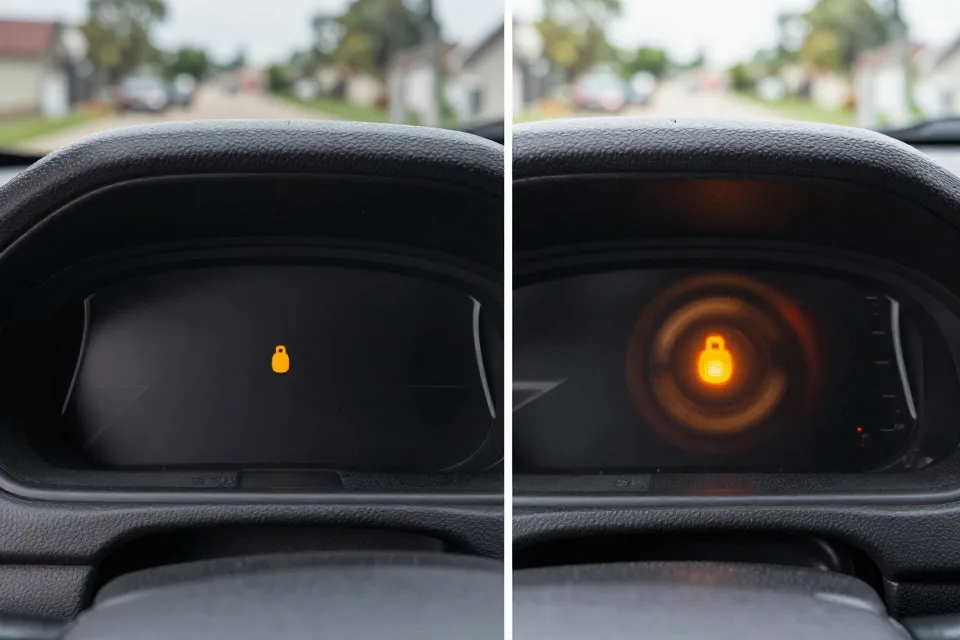
Not every check engine light deserves the same response. AAA says a flashing light calls for caution: the condition is active right now. If the car is losing power, shaking, or giving off a strange odor, pull over at the first safe spot and get help.
A steady light is a quieter message. According to AAA, it is generally fine to drive short distances as long as the car shows no obvious problems. Carfax notes that a steady light often traces to routine causes such as a loose gas cap. Still, do not let it slide for long — the underlying problem will not heal itself, and small issues grow expensive when ignored. There is a fuel-economy angle too: the U.S. Department of Energy reports that fixing a car that is noticeably out of tune can improve gas mileage by about 4% on average.
Common Mistakes to Avoid
A few predictable mistakes turn small bills into big ones:
-
Assuming the code names the broken part. A P0420 converter code can be triggered by a bad oxygen sensor or an exhaust leak. The code is a clue, not a part number.
-
Clearing the code and forgetting about it. Erasing a code also erases the freeze frame data and resets the readiness monitors. You lose information and gain nothing.
-
Ignoring a flashing light. A flashing check engine light is the car asking for attention now. Keep driving and you risk a far larger bill.
-
Buying the cheapest scanner and expecting everything. Entry-level readers cover generic powertrain codes only. Airbag, ABS, and manufacturer-specific codes need a more capable tool.
-
Letting a free scan talk you into a big repair. A parts-store scan is a convenience, not a diagnosis. If a shop quotes $1,300 for a converter, ask how the converter itself was tested, not just which code came up.
-
Skipping the gas cap check. Before anything else, tighten the cap and see whether the code clears. It is the cheapest fix in the book.
-
Clearing codes right before an emissions test. Monitors need time to reset. Drive first, test later.
Where to Get Your Car Scanned
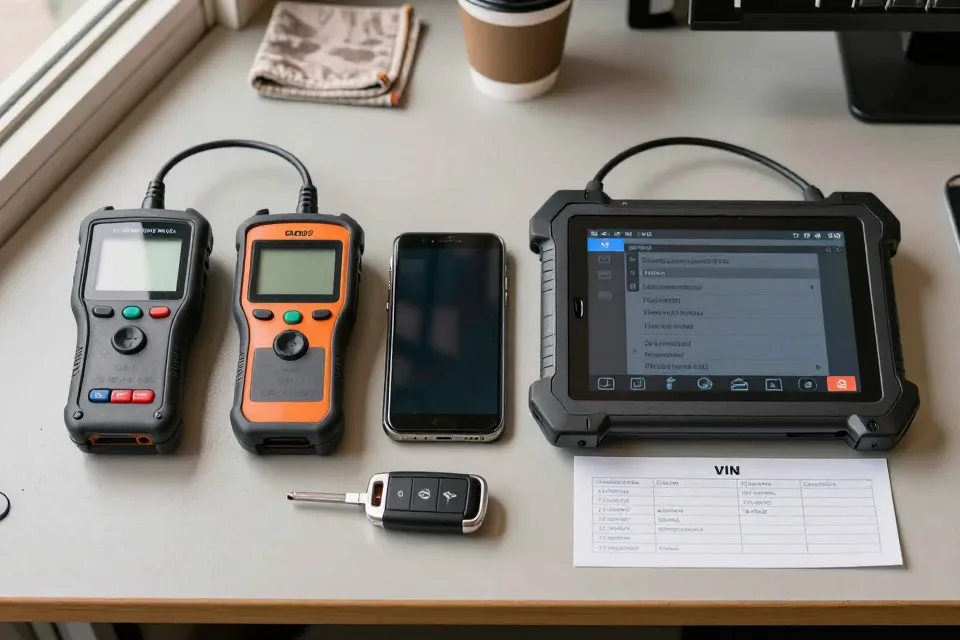
You do not have to buy anything to get started. Many auto parts chains, including Advance Auto Parts and AutoZone, will read your codes at no charge. The catch: a free scan is a starting point, not a full diagnosis, and the store's business is selling parts. Take the code, look it up, and get a second opinion before authorizing major work.
If you would rather own a scanner, prices start around $50 for a basic code reader — enough to read and clear generic codes and view freeze frame data, as Carfax notes. Bluetooth models pair with a phone app, add live data and repair guidance, and cost more. Car and Driver, which tests these tools, points out that budget scanners may miss codes from airbag, ABS, and transmission systems, so match the tool to your needs, not just the price tag.
One more smart use: shopping for a used car. The FTC recommends an independent inspection and a vehicle history report before you commit. A quick scan can surface stored or pending codes the seller never mentioned — and a “Not Ready” monitor on a car that is driven daily is a red flag worth questioning.
The Bottom Line: A Six-Step Plan
An OBD2 scanner will not fix your car, and it will not make you a mechanic. What it does is remove the mystery. It tells you whether the problem is a $28 gas cap or a $1,300 converter, whether the car is safe to drive, and whether the quote you are holding is fair. The whole routine in six steps:
-
Find the port under the dash and plug in the scanner.
-
Read the code and write it down — the letter prefix matters.
-
Look up the code and check the freeze frame data.
-
If the light is flashing, keep trips short; if it is steady, you have time.
-
Try the cheap fixes first, starting with the gas cap.
-
Get a second opinion before any large repair, and never clear codes right before an emissions test.
Next time that amber light appears, you will know exactly what to do. For a tool that costs less than a tank of gas, that peace of mind is a bargain.
This guide is for general information only and is not professional mechanical, financial, or legal advice. Please read our disclaimer before acting on anything here.
Sources
- [authority] https://nepis.epa.gov/Exe/ZyPURL.cgi?Dockey=P100LW9G.TXT