
How to Jump-Start a Car the Safe Way
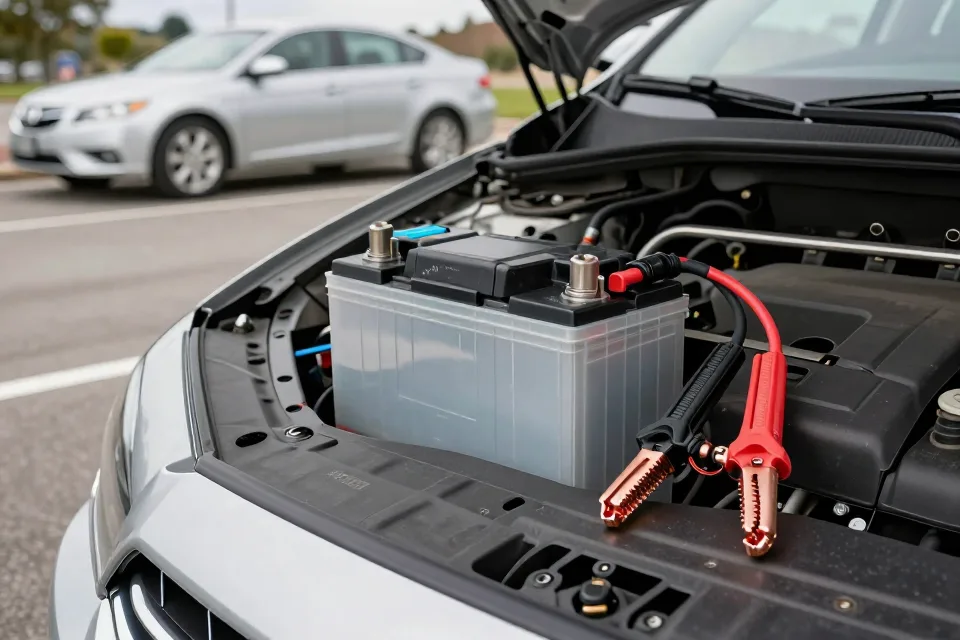
A dead battery has a way of picking the worst moment to quit — a cold morning, a full parking lot, a long trip with nowhere to stop. The starter clicks, the dash lights dim, and the car refuses to turn over. It is one of the most common reasons a car will not start, but it is also one of the easiest problems to solve. Jump-starting is a basic skill you can pick up in one sitting, and most of the job is just following a simple order.
The catch is that the job has a right way and a wrong way. Hook the cables up in the wrong order, or clamp to the wrong spot, and you can damage two cars' electronics — or, in rare cases, cause a battery to explode. This guide covers the safe method step by step, in plain language you can use at the side of the road.
Before you reach for the cables, read the clues
Not every "won't start" is a dead battery, so spend a minute listening before you pop the hood.
-
Rapid clicking, no crank. The starter is trying, but the battery cannot deliver enough power. A jump usually fixes this.
-
One slow, tired crank. The engine turns once or twice and gives up. The battery is weak, and a jump will likely get you going.
-
Complete silence. Turning the key does nothing at all. This can still be a battery problem, but it can also be a starter, ignition, or safety-switch issue. A jump may not help.
-
Dull or flickering dash lights. Weak electrical power often shows up as dim lights before the car fails to start.
Also give the battery a quick look before you connect anything. If the case is cracked, bulging, or leaking, or you smell rotten eggs, do not jump it. That battery needs a professional, not a boost.
The battery is more dangerous than it looks
A car battery does not look threatening, but it deserves respect. While it charges, it gives off hydrogen gas, which is highly flammable. A single spark — from a cable clamp, a cigarette, or static — can ignite that gas and blow the top off a battery. That is why the safety steps matter more than speed.
-
Keep flames and sparks away. No smoking, no open flames, and no welding or grinding near the battery.
-
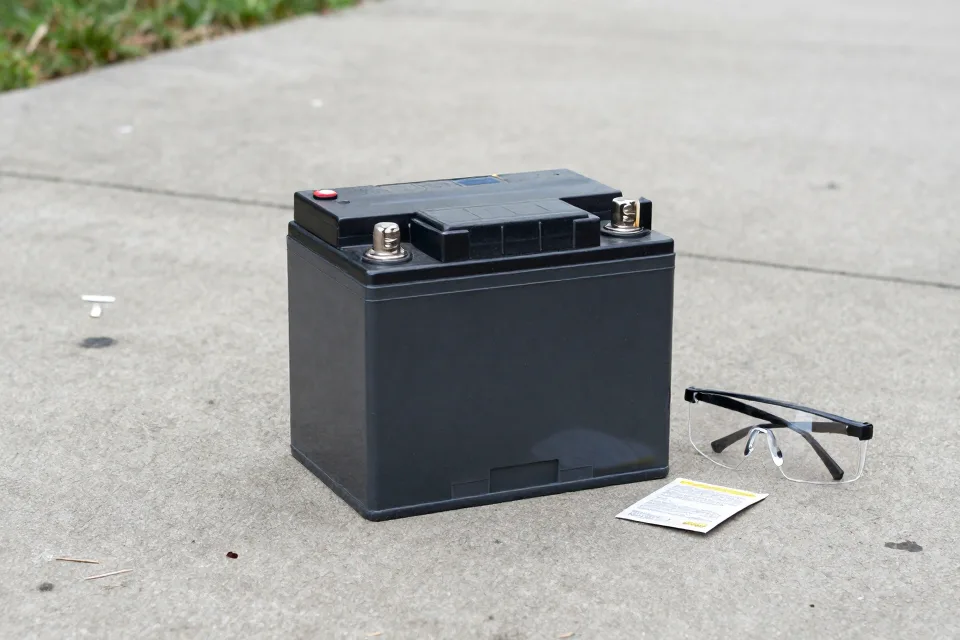
Wear eye protection. Safety glasses are cheap insurance. The gas and acid can do real damage to your eyes.
-
Do not lean over the battery while you work the clamps.
-
Never jump a frozen battery. If it is extremely cold and the battery is frozen, a jump can cause it to explode. Let it warm up and get help instead.
-
Treat the acid with respect. Battery acid is corrosive and will damage paint, fabric, and skin. Rinse any contact with plenty of water.
None of this is meant to scare you off. It is meant to remind you that the procedure is simple, but it is not a place for shortcuts.
What you need for a safe jump
The gear list is short: a working car with a healthy 12-volt battery — or a portable jump pack — plus a set of jumper cables and a few minutes of patience.
-
A donor car. Any car with a healthy battery will do. Park it close enough for the cables to reach, but do not let the two vehicles touch.
-
Jumper cables. For most cars and light trucks, look for cables in the 4- to 6-gauge range — the lower the number, the thicker the wire and the more current it can carry. Thick cables start big engines more reliably, and longer cables make positioning easier. The clamps should be clearly marked red for positive and black for negative.
-
A portable jump pack (optional). A charged jump pack does the same job without a second car. Read its instructions before you need it, not when the battery is dead.
Before you connect anything, prepare both cars: engines off, keys out of the ignition, parking brakes set, and headlights, radio, and other accessories turned off. If your car has an automatic transmission, put it in park; if it is a manual, put it in neutral.
If your owner's manual has a jump-start section, read it first. Hybrids, electric cars, and some luxury models have special rules, which we cover below.
The safe hookup order, step by step
This order is the heart of the whole job. Follow it exactly and you will be fine. Skip a step and you invite trouble.
-
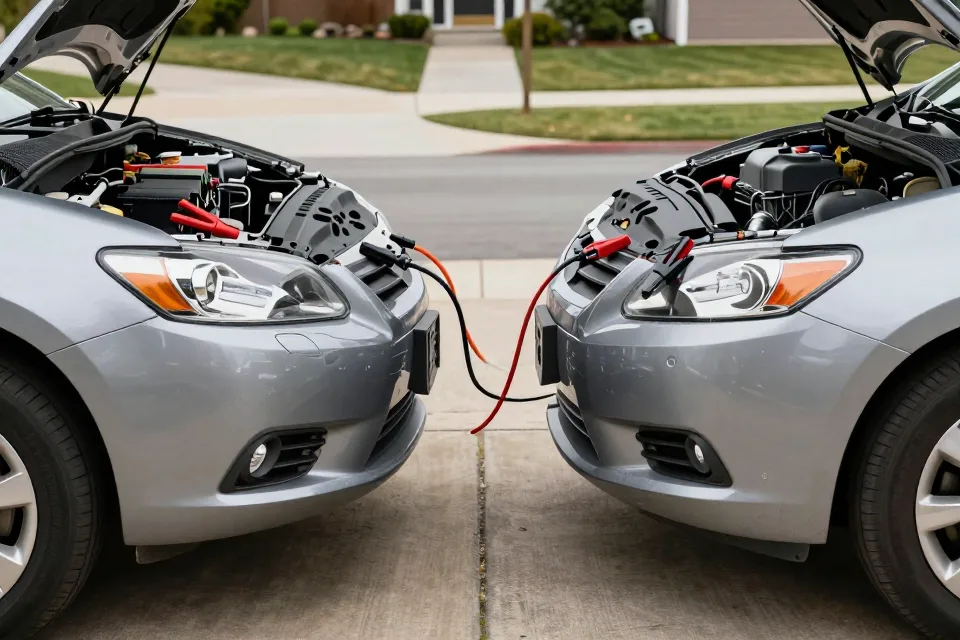
Red to the dead battery (+). Clamp one red end to the positive post of the dead battery. If the post is crusty with corrosion, scrape it lightly so the clamp gets a solid bite.
-
Red to the donor battery (+). Clamp the other red end to the positive post of the donor battery.
-
Black to the donor battery (−). Clamp one black end to the negative post of the donor battery.
-
Black to bare metal on the dead car. Clamp the final black end to an unpainted bolt or bracket on the dead car's engine or frame, well away from the battery. This last clamp is the one most likely to spark, which is exactly why it goes on engine metal and not on the battery itself.
Two rules while you work: never let the two clamps touch each other, and never connect a red clamp to a black post. A wrong connection can short the system and damage electronics in both cars.
Start it up — then remove the cables in reverse
Once everything is clamped, start the donor car and let it idle for about five minutes. That gives the dead battery time to take on some charge. Then try the dead car. If it does not start on the first try, wait a minute or two and try again — but stop after two or three attempts. Cranking over and over drains the donor and stresses the starter.
When the dead car is running, remove the cables in the exact reverse order: black clamp off the dead car's engine metal first, then black off the donor battery, then red off the donor, and finally red off the dead battery. Keep the clamps from touching each other as you go.
After the jump: recharge and get tested
A jump start does not fully recharge a dead battery. It only gives the battery enough power to start the engine; the alternator does the real recharging while you drive. If you shut the engine off right away, you may be jumping the car again within minutes.
Plan to drive for at least about 30 minutes — or let the engine run for a while — before you turn the car off. That gives the alternator time to refill the battery.
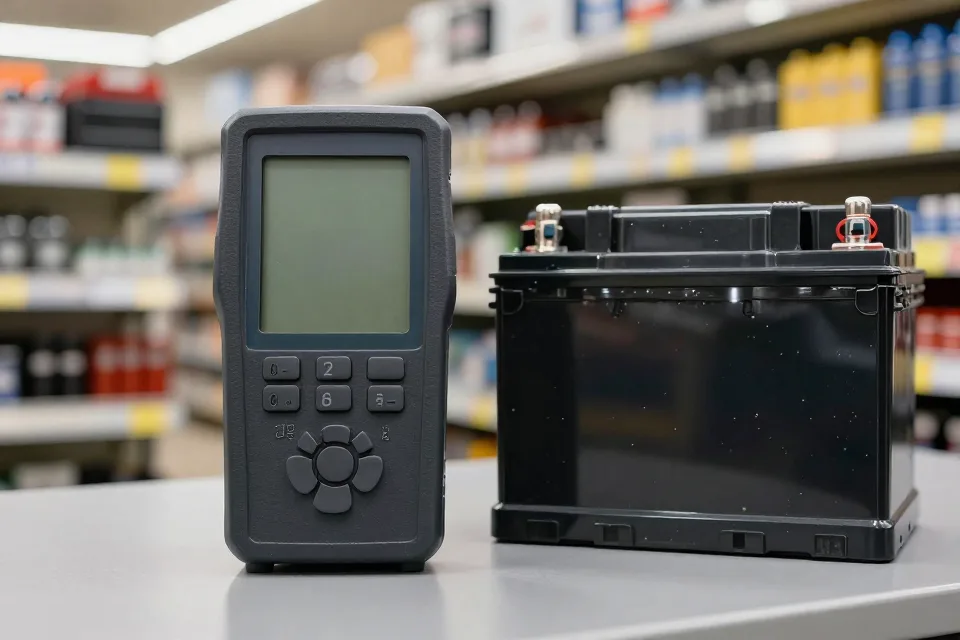
Then have the battery and charging system tested within a day or two. Many auto parts stores do this for free. If the battery warning light stays on after the jump, the alternator may be the real problem, not the battery. And if your battery is three to five years old, a jump may simply be a sign that it is ready to retire.
Common mistakes that turn a jump into a repair bill
| Mistake | What can go wrong | What to do instead |
| --- | --- | --- |
| Clamping the last black cable to the dead battery's negative post | Sparks right next to battery gas | Clamp it to bare engine metal instead |
| Letting the two clamps touch | Sparks and a short circuit | Keep the handles apart as you work |
| Cranking over and over | Drains the donor and stresses the starter | Limit yourself to two or three tries |
| Jumping a cracked, leaking, or frozen battery | Explosion risk | Call a professional instead |
| Skipping eye protection | Acid or gas can injure your eyes | Wear safety glasses |
| Shutting the engine off right after the jump | Battery still too low, so you jump again | Drive about 30 minutes first |
| Swapping red and black | Serious electrical damage | Double-check the markings before you clamp |
| Jumping a hybrid or EV like a gas car | Damage or high-voltage danger | Check the owner's manual first |
When to skip the jump and call for help
Sometimes the smartest move is to not jump at all. If the battery is cracked, leaking, swollen, or frozen, stop and call for roadside assistance. The same goes if the car still will not start after two or three tries — the problem may be the starter, the alternator, a fuel issue, or wiring, and guessing gets expensive.
Hybrids and electric cars need special care. Many have a small 12-volt battery that can be jumped, but some do not allow jump-starting at all, and the high-voltage system is dangerous for amateurs. Always check the owner's manual before you touch anything under the hood of a hybrid or EV.
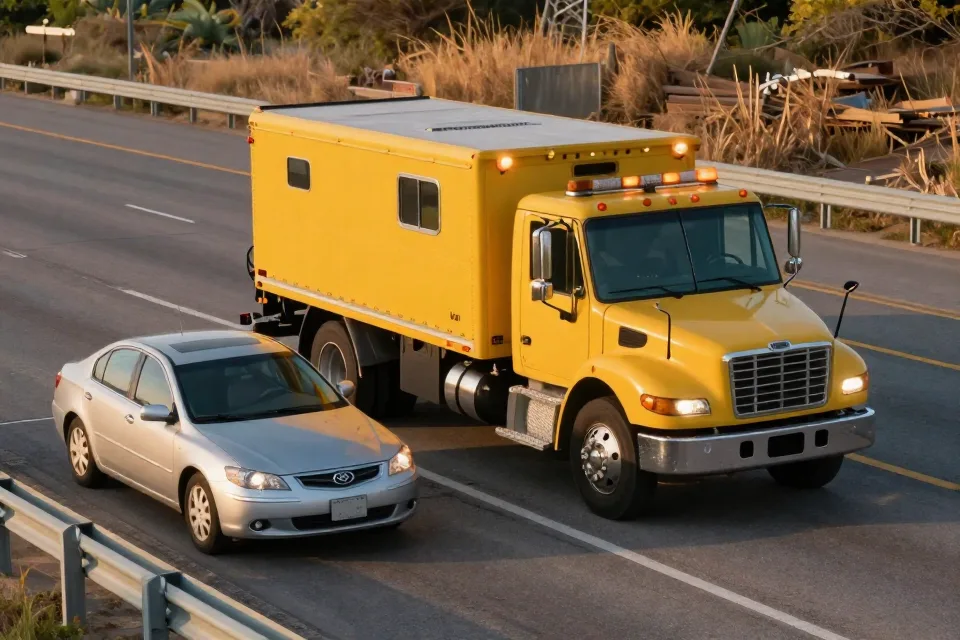
Roadside assistance is not admitting defeat. A professional can test the battery, check the charging system, and often fix the problem on the spot — which beats a tow truck after a botched jump.
Jump-start checklist
Run down this list before you begin, and again as you finish:
-
Both cars parked close together but not touching
-
Both engines off, keys out of the ignition
-
Parking brakes set; transmission in park (or neutral)
-
Headlights and accessories turned off
-
Safety glasses on; no smoking or open flames nearby
-
Battery case looks intact — no cracks, leaks, or swelling
-
Cables undamaged, with clamps marked red and black
-
Hookup order: red to dead (+), red to donor (+), black to donor (−), black to engine metal
-
The two clamps never touched each other
-
Donor car idled a few minutes before starting
-
Cables removed in reverse order after the start
-
Drove about 30 minutes before shutting off
-
Battery and charging system tested within a day or two
Keep your car ready for the road ahead
Jump-starting is one of the most useful skills a driver can keep in their back pocket. With the right order and a little patience, a dead battery becomes a fifteen-minute delay instead of a ruined day. When a battery finally retires, remember that it is one of the most recycled products in the country — nearly all lead-acid batteries are recovered and made into new ones. Have yours recycled, and give your next battery a fair start.
This article is for general information only and does not replace the advice in your vehicle's owner's manual or a qualified mechanic for your specific car. See our full disclaimer for details.
Sources
- [reference] https://www.edmunds.com/how-to/jump-start.html