
School Zone Rules Every Driver Must Remember
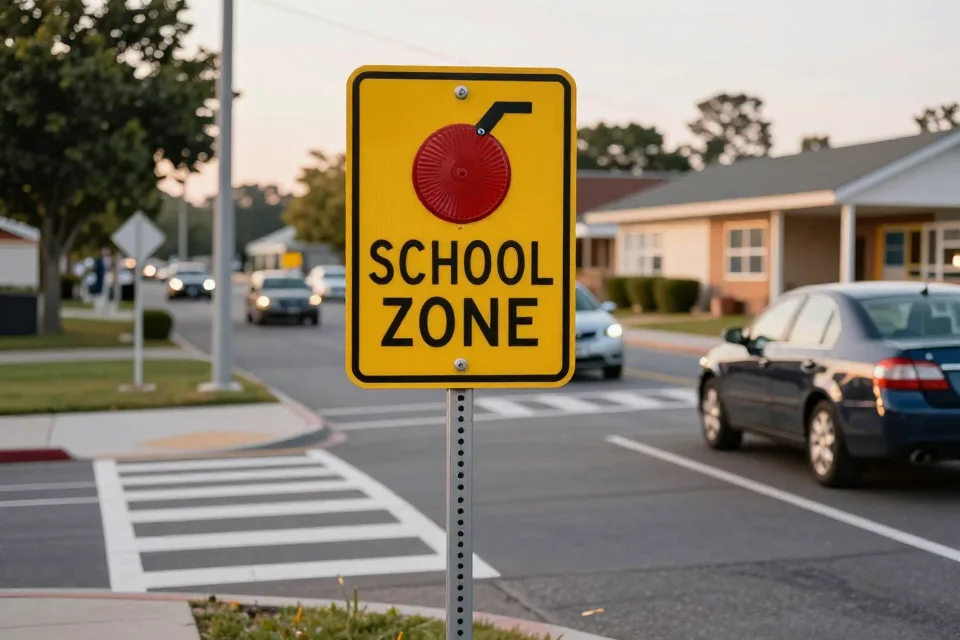
The Shortest, Most Rule-Crammed Miles in America
A school zone is usually no more than a few hundred yards of pavement, yet no other stretch of a typical commute squeezes in so many signs, lights, laws, and unpredictable people. On weekday mornings, those blocks fill with children who are small, quick, and easy to miss from a driver's seat. They are also the hours when school-age pedestrians are most often killed in crashes tied to school transportation — more died between 7 and 8 a.m. than during any other hour of the day, according to a ten-year NHTSA review.
This article walks through the rules that matter most for drivers over 45 — many of whom now find themselves shuttling grandchildren to school or driving through neighborhoods where kids are walking. You'll get the speed-limit basics, the school bus laws that apply in every state, the phone rules that are easy to trip over, and a closing checklist you can keep in the glovebox.
Why School Zones Demand More Than Slow Driving
The numbers explain why communities treat these blocks differently. In 2022, 104 people died in crashes related to school transportation, according to NHTSA. Look at the ten-year window from 2013 to 2022 and more than 1,000 people lost their lives in those crashes; 198 of them were children 18 or younger.
Here is the part that surprises most drivers: the majority of those children were not riding the bus. Among the children killed, 40 percent were occupants of other vehicles, 38 percent were pedestrians, 18 percent were riding in the school transportation vehicle, 3 percent were on bicycles, and 1 percent were using personal devices such as skateboards or scooters, per NHTSA.
Pedestrians face the steepest exposure. Nationwide, 7,080 pedestrians were killed on U.S. roads in 2024, NHTSA reports. In school-transportation crashes specifically, nearly two-thirds of the school-age pedestrians who died over the past decade were struck while getting on or off a school bus. And a separate ten-year NHTSA review found that about two-thirds of those pedestrian deaths occurred away from intersections — in places where no crosswalk was there to guide the child.
None of this means the yellow bus is the danger. NHTSA research calls the school bus one of the safest ways to get to school: students are nearly eight times safer riding the bus than riding in a car driven by a parent or guardian, with a fatality rate of 0.2 deaths per 100 million vehicle miles traveled versus 1.5 for cars. The risk sits just outside the bus — in the 10-foot danger zone around it where drivers and children compete for space.
School Zone Speed Limits: Know the Number and When It Applies
Most school-zone speed limits fall between 15 and 25 mph, according to the Federal Highway Administration. Florida's law, as one example, holds school-zone limits between 15 and 20 mph. The exact number on the sign in your town is the only one that matters legally — read it every time, because the limit can change from block to block.
The harder question is when the lower limit applies. Some zones are posted "when children are present," others "when flashing," and the difference matters. Oregon's transportation department explains it plainly: a limit can be tied to children being present at any time on any day, or to a flashing beacon that switches the limit on. If the sign says "when children are present," kids at an after-school program on a Saturday afternoon count. If the sign says "when flashing," the reduced limit is only in force while the beacon is on.
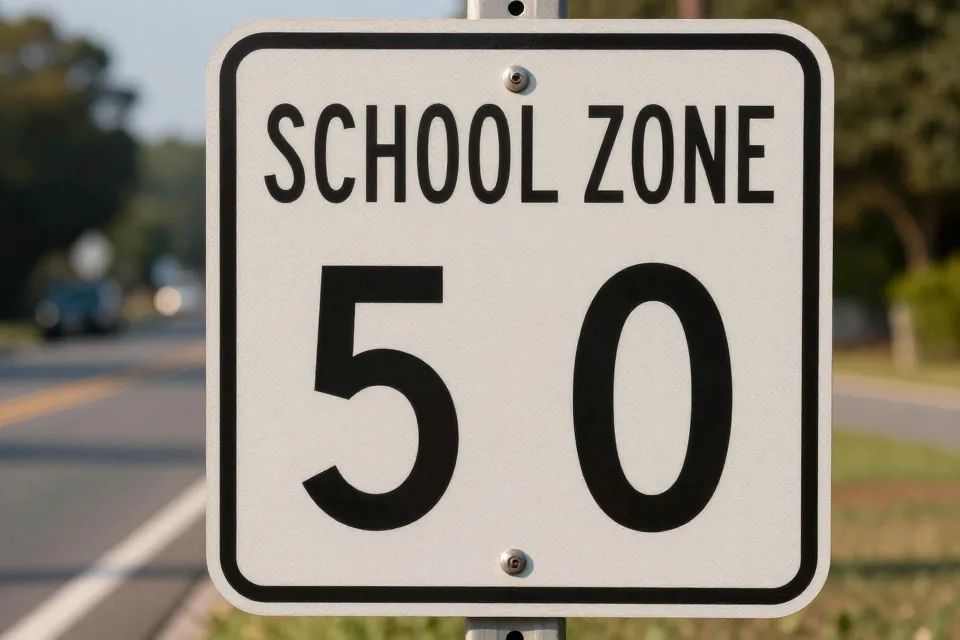
Some states spell the window out in law. Nevada, for example, enforces its 15 mph school-zone limits during the 30 minutes before and after the school day, or while the beacon is flashing, according to the state's Traffic Safety Research Group at UNLV. Whatever the wording, the safe habit is the same: expect the reduced speed to be in effect whenever you see children, crossing guards, buses, or flashing beacons.
The stakes are not just safety — they are financial. Many states treat school-zone violations more harshly than the same offense elsewhere; New York, for example, doubles the fine for speeding in a school zone. Florida, meanwhile, authorizes automated speed-detection cameras in school zones, so a citation can arrive by mail without a patrol car in sight.
The School Bus: When You Must Stop
The single most important bus rule is also the simplest: all 50 states, plus the District of Columbia and U.S. territories, make it illegal to pass a stopped school bus with its red lights flashing and its stop-arm extended. NHTSA notes that every state prohibits passing a stopped bus from the rear, and all states ban passing from the front in at least some situations, such as on an undivided roadway.
The lights tell the story in two steps. Flashing yellow means the bus is preparing to stop — slow down and be ready, not eager to sneak past. Flashing red means the bus is stopped and children are getting on or off — you must stop. AAA's driver guidance describes the sequence exactly this way: yellow is the warning, red is the command to stop.
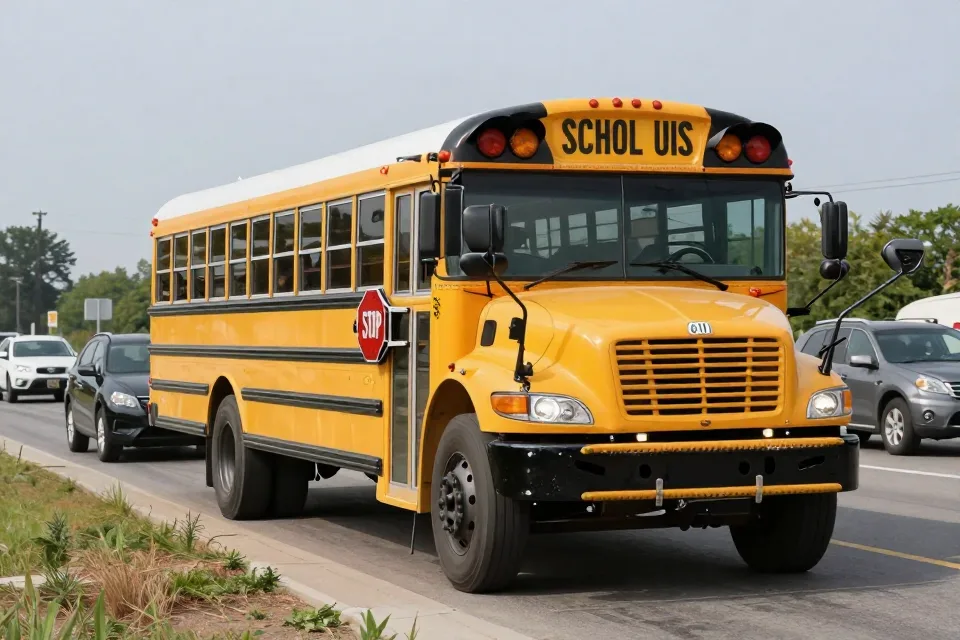
Who must stop depends on the road. On a two-lane road, and on undivided roads of any width, traffic in both directions must stop for a bus loading or unloading students, per the Georgia Department of Driver Services. The exception: on a divided highway with a raised median or physical barrier, only traffic traveling in the same direction as the bus must stop. Traffic coming the other way may proceed — but slowly and carefully, because children can still cross.
Give the bus room. Maryland law, for example, requires drivers to stop at least 20 feet from a stopped bus. The space matters because of the danger zone: the 10 feet on every side of the bus where children are hardest for the driver to see and most exposed to traffic, as NHTSA describes it. Leave enough room that a child stepping off the bus has space to stand clear.
Why be so strict? Because the riskiest part of the school commute is the handoff, not the ride. From 2015 to 2024, about 71 percent of the deaths in school bus-related crashes were occupants of other vehicles, and 15 percent were pedestrians, according to the National Safety Council's Injury Facts. A growing number of states now allow cameras on school buses to catch drivers who pass illegally, NCSL reports — so the driver who thinks they "got away with it" may find a ticket in the mail.
Phones Down: Distracted Driving Rules You Can Trip Over
Distraction is a problem everywhere, but school zones make it unforgiving. The laws are also stricter than many drivers realize. Thirty-six states and the District of Columbia ban all cellphone use by novice and teen drivers, and 20 states plus D.C. prohibit any cellphone use by school bus drivers, according to NCSL.
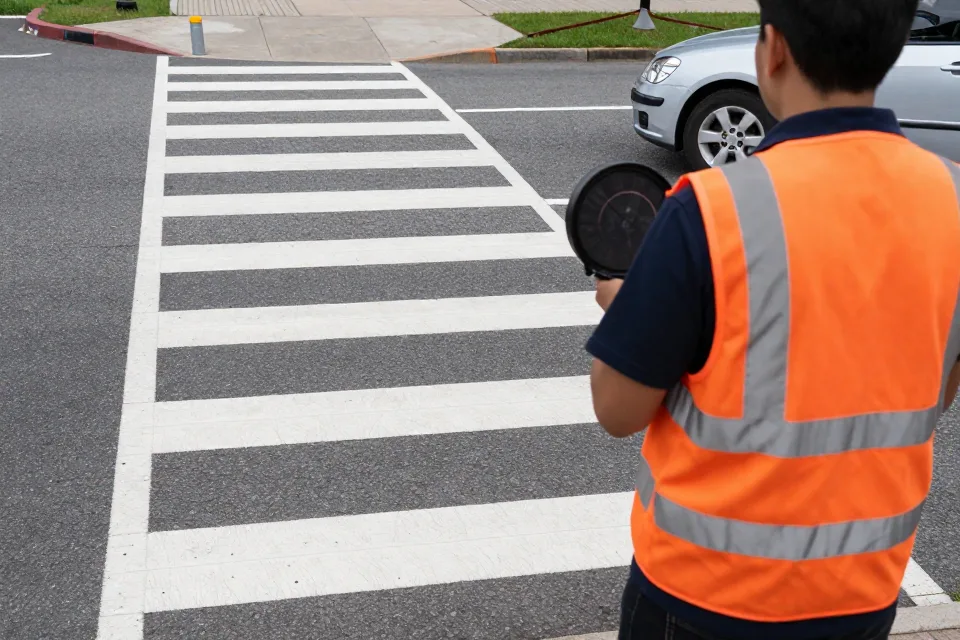
A handful of states go further and ban handheld phones specifically in school zones. Texas law, for example, makes it illegal to use a handheld device in a school crossing zone, and texting while driving is banned for all drivers there. Arkansas and Florida restrict handheld use to school and work zones for all drivers, per the Governors Highway Safety Association. Across the country, 48 states plus D.C. ban texting while driving for everyone, according to the Bureau of Transportation Statistics.
Even where hands-free use is legal, the wise move in a school zone is to put the phone down entirely. A child can step off a curb between two parked cars in the time it takes to read one line of a text. Whatever the law allows, nothing in a school zone deserves your attention more than the road.
Crossing Guards, Crosswalks, and the Children You Can't See
The National Safety Council's school-zone guidance for drivers is a good checklist on its own: when a school zone's flashers are blinking, stop and yield to pedestrians at the crosswalk or intersection; always stop for a crossing guard holding up a stop sign; never pass a vehicle that has stopped for pedestrians; and don't honk or rev your engine to hurry a pedestrian along, even if you have the right of way.
Children are the wild cards. NHTSA advises that children under 10 walk to school with an adult or a responsible older companion. On the road, that means the child who should be holding a hand may instead be darting between cars. NSC adds two more watch points: bikes can come out of driveways without warning, and young riders often turn without signaling — so check your mirrors before moving off, and look twice before opening a door after parking.
Drop-Off and Pickup: The Busiest Minutes of the Day
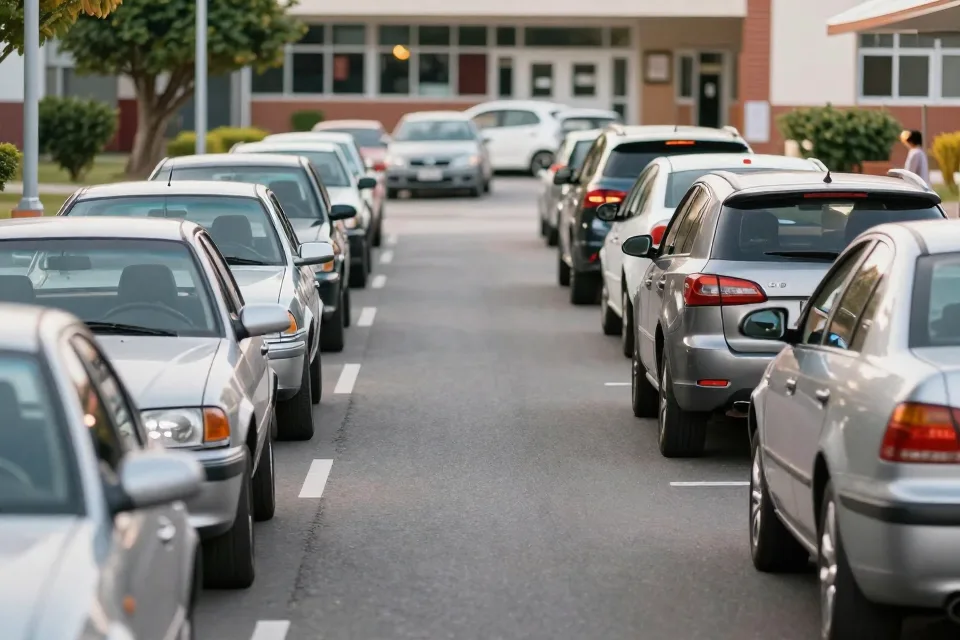
The most chaotic traffic of the school day isn't on the road — it's in the school driveway. NSC's advice for these minutes: don't double-park, because it blocks visibility for children and other drivers; load and unload on the school side of the street, never across it; and carpool when you can to shrink the line of cars. Add time to your schedule so you are never rushing through the zone.
When grandchildren are in your car, one more rule applies even before you reach the zone: children under 13 should ride in the back seat, per the American Academy of Pediatrics' best-practice guidance. And use the passenger-side door for loading and unloading whenever you can — it keeps kids on the curb side, away from traffic.
Common Mistakes Even Careful Drivers Make
Even experienced drivers slip on these habits. If any sound familiar, you are not alone — but each one is worth breaking.
-
Speeding up when the bus lights turn yellow. Yellow means the bus is about to stop. Treat it as a brake warning, not a race signal — children may already be moving toward the door.
-
Assuming the school zone is "off" outside school hours. "When children present" zones can be live on weekends and holidays if kids are out. When in doubt, drive the reduced speed; the ticket and the risk both favor caution.
-
Passing the car stopped at a crosswalk. The driver ahead may be stopped for a child you cannot see. Passing that stopped car is illegal in many states and dangerous in all of them.
-
Stopping too close to the bus. The 10-foot danger zone around the bus exists for a reason. Stop far enough back that a child stepping off has room to stand clear — some states require 20 feet or more.
-
Checking the phone at the red light. School-zone phone rules often still apply at a stop, and the light can change while you glance down. Keep the phone in the glovebox for the whole trip through the zone.
-
Unloading kids on the traffic side or double-parking. It saves a minute and can cost a child's life. Pull fully into the designated area and use the curb-side door.
Your School Zone Checklist
- Slow to the posted school-zone limit before you reach the sign; children do not wait for signage
- Put the phone away before entering the zone, and leave it there
- Watch the bus lights: yellow means prepare to stop, red means stop
- On undivided roads, stop for a loading bus in both directions; on divided highways, only the bus's side must stop
- Stop far enough behind the bus to leave the 10-foot danger zone open
- Stop and yield whenever a school zone's flashers are blinking
- Obey the crossing guard's stop sign without hesitation
- Never pass a vehicle stopped at a crosswalk
- Load and unload on the school side, curb-side door, and keep kids under 13 in the back seat
- Leave home five minutes earlier so you are never rushing
No checklist replaces judgment, and no article replaces your state's driver manual. But drivers who treat school zones as the most serious few hundred yards of the day are the ones who never regret it.
The information in this article is general guidance, not legal advice or a substitute for the traffic laws in your state. For more on how we handle content, see our disclaimer.
Sources
- [authority] https://www.nhtsa.gov/school-bus-safety/reducing-illegal-passing-school-buses