
Towing a Boat: What You Need to Know Before You Launch
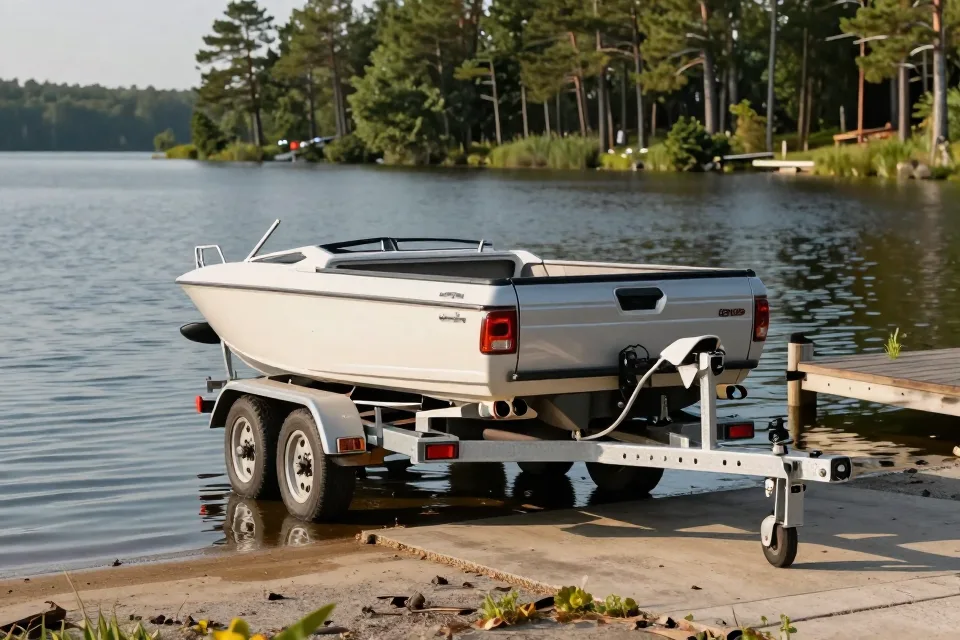
Before You Hook Up, Read This
There's nothing quite like the first trip to the ramp with a new boat. The water is waiting, the family is buckled in, and the trailer is hooked up behind you. Then a quiet voice in your head asks the question nobody wants to hear: did I miss something?
Towing a boat looks simple — a hitch, a ball, and you're off. In practice it's a chain of details, and the chain is only as strong as its weakest link. Get the numbers right, check the hardware, and drive with a steady hand, and you'll be backing down the ramp like a veteran. Skip a step, and you're the rig on the shoulder with a hot hub and a family that has stopped enjoying the trip.
This guide walks through the essentials in the order you'll meet them: the numbers, the hitch, the trailer, the legal basics, the tires, the drive, and the ramp. Read it once before you hook up, and keep it in mind every time after.
Start With the Numbers, Not the Hitch
Before you shop for a ball mount, find out what your vehicle can actually pull. The towing capacity in your owner's manual is the manufacturer's maximum, and it's the first number to know — but it is not the only one that matters. Industry towing guides are blunt about this: towing capacity alone doesn't tell the whole story. CURT's towing guide and eTrailer's trailer math both explain the full set of ratings.
Here are the four you need:
-
Towing capacity — the most your vehicle can pull, set by the manufacturer.
-
Payload — the weight of everyone and everything inside the vehicle. Check the placard on the driver's door frame; it's often lower than people expect.
-
GVWR (gross vehicle weight rating) — the most your vehicle can weigh, fully loaded.
-
GCWR (gross combined weight rating) — the most your vehicle plus trailer can weigh together.
Add up the boat, the trailer, the fuel, the gear, and the family. The total must fit under both the GVWR and the GCWR. That's the math that keeps you legal and stable.
One trap catches first-time towers every season: the boat's "dry weight" from the brochure is almost never the real number. It leaves out fuel, batteries, coolers, life jackets, and the water still sloshing in the bilge. Plan around the loaded weight, not the showroom figure. eTrailer
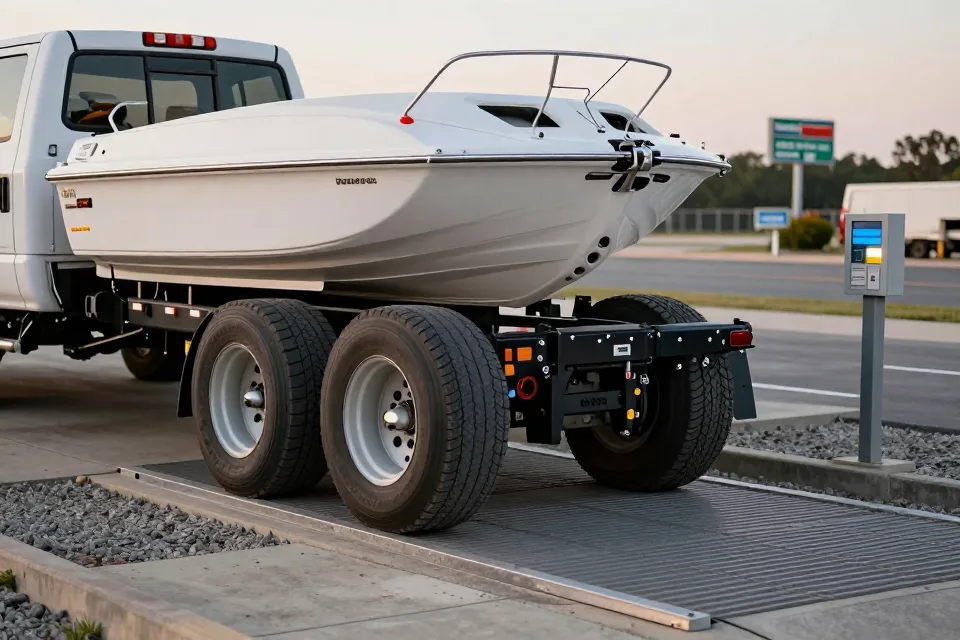
Want certainty? After loading the boat once, run the rig across a public scale — truck stops charge a few dollars. Now you know exactly where you stand instead of guessing.
Match the Hitch to the Job
Trailer hitches are rated in classes, and each class has a weight ceiling. The typical ranges: Class I handles about 2,000 pounds, Class II about 3,500, Class III roughly 5,000 to 6,000 (and more with a weight-distribution hitch), Class IV up to about 10,000, and Class V beyond that. eTrailer's receiver guide and this hitch primer lay out the full ladder.
Three details people forget:
-
The receiver opening on your vehicle comes in set sizes — commonly 1.25 inches or 2 inches. The hitch you buy must fit the opening and be rated for the trailer's weight.
-
The ball must match the coupler on the trailer and carry its rating. A ball rated for 3,500 pounds has no business under a 5,000-pound boat.
-
For heavier rigs, a weight-distribution hitch spreads the load across the truck's axles and evens out the ride — Consumer Reports' towing guide explains when you genuinely need one. Most small and mid-size boat trailers are fine with a plain ball mount.
The Trailer Has Its Own Limits
The trailer is a vehicle too, with its own ratings. Its GVWR is the most the loaded trailer may weigh, and each axle carries a gross axle weight rating (GAWR). Load past either one and you stress the frame, the tires, and the bearings — and you may be breaking the law. CURT's towing math covers both.
Tongue weight — the downward force the coupler puts on the ball — does more to your handling than any other number. The rule of thumb is about 10 to 15 percent of the loaded trailer weight on the tongue. Too little, and the trailer wanders side to side. Too much, and the rear of your vehicle squats while the steering goes light. CURT
Loading rule: keep heavy items low and centered, and balance the boat front-to-back so the tongue lands in that 10-to-15 percent zone. A trailer that came set up from the dealer usually needs no rebalancing — but if the rig feels twitchy at speed, check the tongue weight before you blame the road.
Brakes, Chains, and Lights: The Legal Basics
Every state expects your trailer to stop, stay attached, and be visible. The specifics vary, so check your own state's rules — here's the shape of the law:
-
Trailer brakes. Most states require brakes on trailers above a weight threshold, commonly around 3,000 pounds of GVWR, with some states lower and a few higher. Some states also demand a breakaway brake that stops the trailer if it comes loose from the truck. The RVIA's state-by-state chart shows the spread.
-
Surge vs. electric. Boat trailers usually use surge brakes, which work off the trailer's own motion and need no controller in the cab. Electric brakes, common on heavier trailers, need a brake controller. Discover Boating and Edmunds both walk through the difference.
-
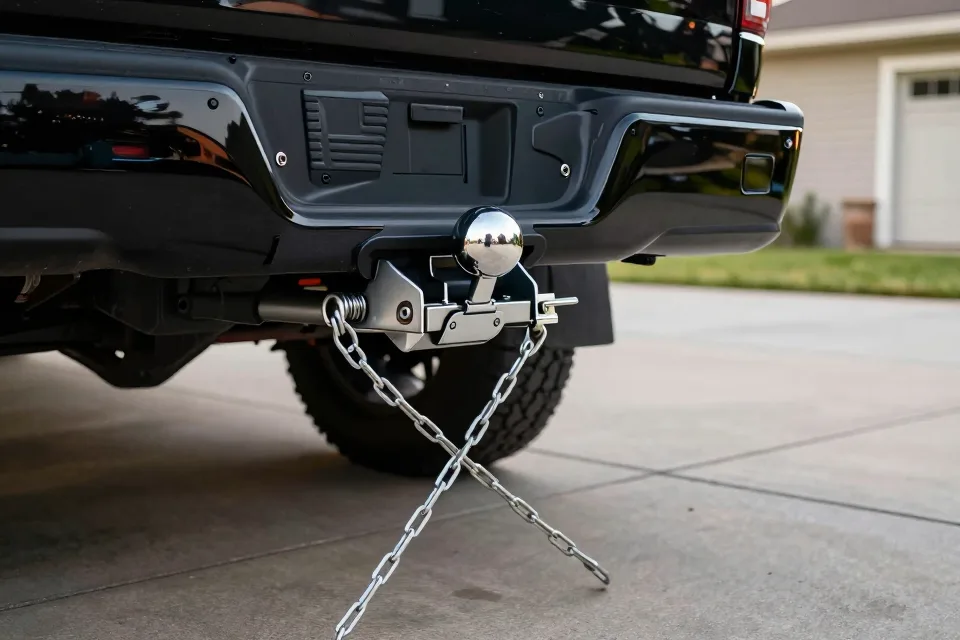
Safety chains. Required in most states, they should cross under the coupler so the trailer stays attached if the ball lets go — with enough slack to turn without dragging. Nebraska's statute is a typical example of the law.
-
Lights. Tail, brake, and turn signals must work, every trip. Test the wiring and the connector before you leave the driveway, and keep connections dry at the ramp — salt water and trailer wiring do not get along. Discover Boating
-
Mirrors. If you can't see past the boat, add towing mirrors before you hit the road. You can't drive what you can't see.
Tires: The Part Everybody Skips
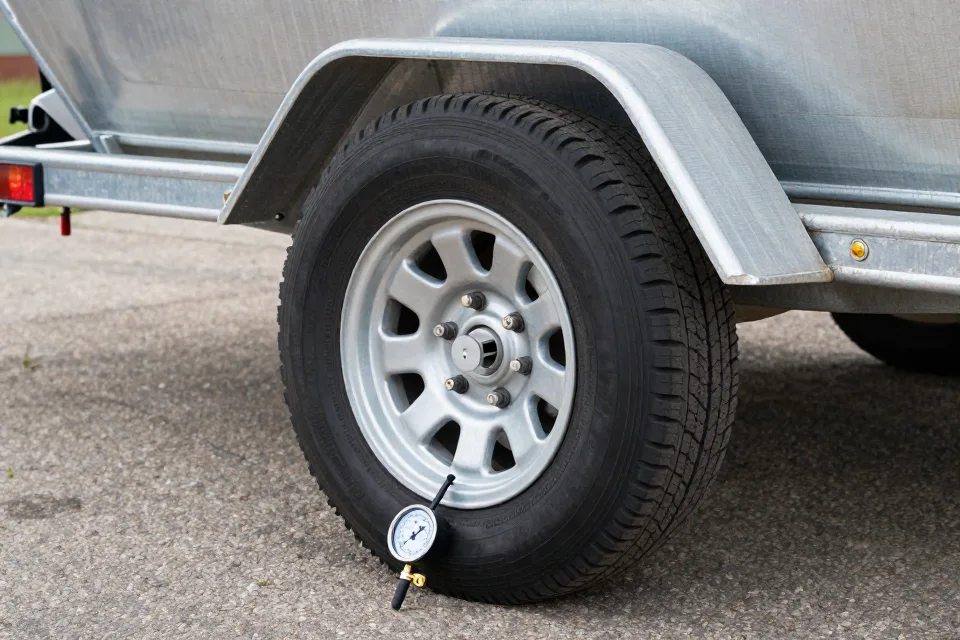
Your tires carry the entire rig, and they get the least attention. NHTSA's guidance is to check pressure at least once a month — and that includes the spare. NHTSA tire safety
Two mistakes to avoid:
-
Inflating to the number on the tire sidewall. That figure is the maximum the tire can hold, not the pressure your vehicle needs. Use the recommendation from the owner's manual or the placard on the driver's door frame — NHTSA is explicit about the difference. NHTSA
-
Trusting old trailer tires. Rubber ages even when it looks perfect and sits unused in a garage; age and condition matter as much as tread. If the boat trailer has been parked for years, have the tires inspected before a highway trip — a blowout at speed with a boat behind you is not an adventure you want. NHTSA tire safety and NTSB research on tire aging
Trailer tires must also be load-rated for the weight they carry. Check the load rating on the sidewall against the trailer's GVWR.
On the Road: Driving With a Boat Behind You
The rig drives differently from your truck alone. Expect slower acceleration, earlier braking, and more room in corners. Consumer Reports has a solid run-through of safe towing habits.
-
Speed. Towing speed limits vary by state, and a few states set a lower cap for trailers than the posted limit for cars. SlashGear's summary is a good starting point. Keep your speed modest regardless — trailer sway most often starts around 55 mph and above, and it builds fast. eTrailer and Trailer Safety Week both flag the same zone.
-
Following distance. Double it. The extra weight stretches your stopping distance, and the boat doesn't help you stop — it pushes.
-
Hills. Drop to a lower gear on long descents and let the engine hold you back. Riding the brakes downhill is how hubs and rotors overheat. Consumer Reports
-
Wind and trucks. Gusts move a trailer more than they move you, and passing trucks shove a boat trailer sideways. Give them extra room.
-
Fuel. Towing costs you at the pump. Every extra 100 pounds in the vehicle can shave about 1 percent off fuel economy — before the trailer's wind drag even gets a vote. fueleconomy.gov has the weight math.
-
Practice. Cars.com's advice to first-time towers: find an empty lot and practice backing, turning, and stopping before you ever point the rig at a ramp. Cars.com
At the Ramp: Launch and Retrieve Without the Drama
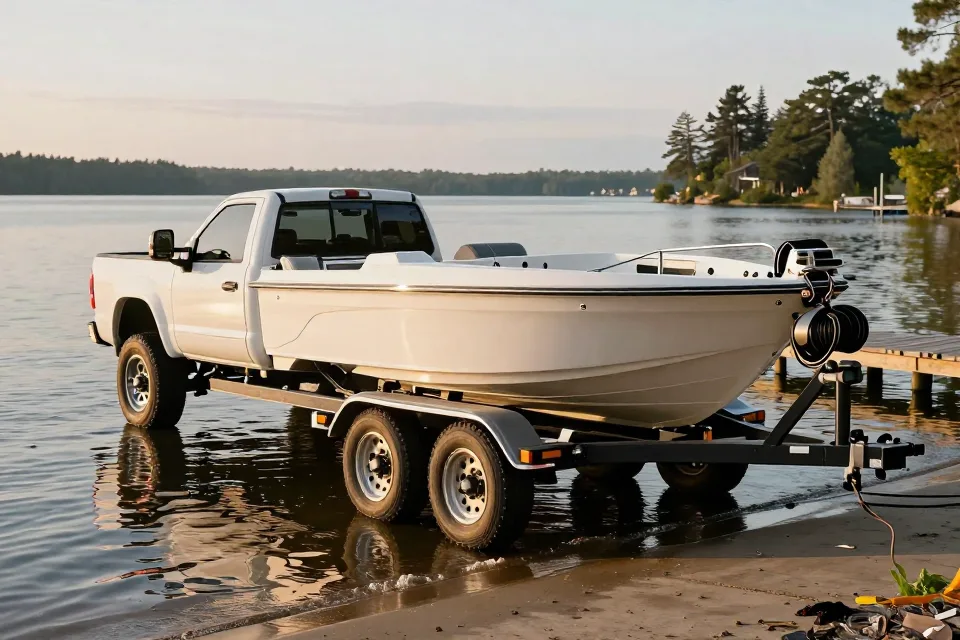
The ramp is where good planning pays off. A few habits keep it calm:
-
Drain plug. Put it in before launch; take it out after retrieval. It's the number one oops of boat ramp season. KBB
-
Back up slowly. There's no prize for the fastest launch. Set the parking brake once the trailer is positioned, then climb out.
-
Don't dunk the hubs. Back in only until the boat floats. Sand and salt in the wheel bearings are a repair bill you don't need — KBB's truck-protection guide shows how deep is too deep.
-
Winch and strap. Before you drive away, crank the boat snug against the bow stop and secure the safety strap. The winch alone is not a tie-down.
-
Walk around. Lights, chains, plug, strap, tie-downs: thirty seconds of checking beats thirty minutes of roadside fixes.
Common Mistakes Even Seasoned Towers Make
Every ramp regular has seen all of these. Break the habits before they cost you a weekend:
-
Trusting the brochure weight. The boat is heavier than you think once it's loaded with fuel and gear.
-
Forgetting the trailer is there. Cutting corners too tight, changing lanes too close, backing into the wrong spot.
-
Riding the brakes downhill. Use a lower gear instead.
-
Skipping the spare and tools. A flat on a boat trailer needs a jack rated for the load and a lug wrench that fits.
-
Letting people ride in the boat on the road. The boat is cargo, not a lounge.
-
Racing the storm. Wet ramps, wind, and low visibility are a bad mix with a trailer.
-
Assuming "it's a short trip, it'll be fine." Most problems happen close to home.
-
Skipping the walk-around. Lights, chains, and the plug take thirty seconds to check.
That list is where most of the misery lives — and every item is avoidable.
Your Pre-Trip Towing Checklist
Run this every time you tow:
-
Loaded rig weight fits your towing capacity, payload, and GCWR
-
Tongue weight about 10 to 15 percent of loaded trailer weight
-
Hitch, ball, and coupler match — and the pin is in
-
Safety chains crossed under the coupler, not dragging
-
Trailer brakes working (and controller set, if electric)
-
All lights working: tail, brake, turn
-
Tire pressures checked, including the spare; trailer tires inspected
-
Drain plug in hand — in before launch, out after
-
Winch snug, safety strap on, tie-downs tight
-
Mirrors adjusted, practice backing done
-
Fuel topped up — towing burns more
Do these eleven things and the only drama on your trip will be the fish.
Final Word
Boat towing is a skill, not a mystery. The numbers are in your manuals, the rules are in your state's laws, and the habits are in this guide. Hook up, double-check, and enjoy the water. This article is general information only and not professional advice — please see our disclaimer for details.
Sources
- [reference] https://www.curtmfg.com/towing-capacity