
Towing a Trailer: Weight, Hitches, and Safety Basics
Towing Changes Everything About How You Drive
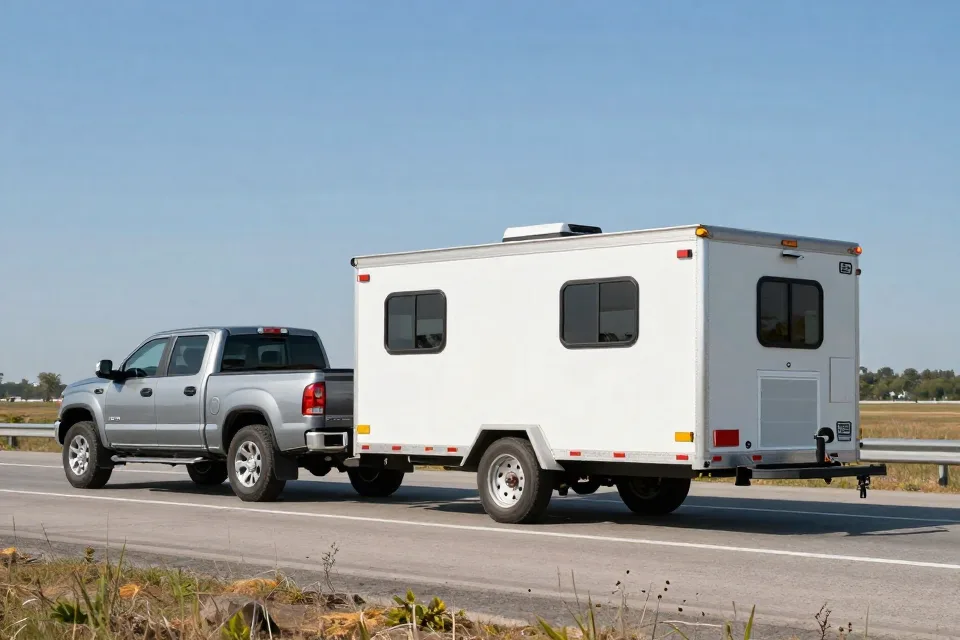
It usually starts with a boat, a camper, or a big home-improvement project. You have a capable truck or SUV, a neighbor who owns a trailer, and a weekend that suddenly looks perfect for a trip. Then you hook up for the first time and realize something important: towing is not driving with a wagon behind you. It is its own skill, with its own numbers, its own equipment, and its own rules.
The good news is that the rules are learnable, and most of them come down to a single idea: never ask any part of the system to do more than it is rated to do. The system is the tow vehicle, the hitch, the trailer, the tires, and the driver. This guide walks through the weight ratings, the hitch classes, and the safety habits that keep a loaded rig stable — in plain English, without the jargon.
Know Your Numbers Before You Hook Up
Vehicle makers publish a handful of weight ratings, and each one answers a different question. Mixing them up is exactly how people end up overloaded without realizing it. You will find them on the driver's door sticker, in the owner's manual's towing section, and on the trailer's own certification label.
| Rating | What it tells you |
| --- | --- |
| GVWR (gross vehicle weight rating) | The heaviest your tow vehicle can be, fully loaded with people, fuel, and cargo |
| GCWR (gross combined weight rating) | The heaviest the truck and trailer can be together, with everything in both |
| Towing capacity | The heaviest trailer your vehicle is rated to pull |
| Payload | How much weight your vehicle can carry in its cab and bed |
| Tongue weight | The downward force the loaded trailer puts on the hitch |
KBB's towing guide lays out these terms plainly. Towing capacity is the maximum trailer weight the vehicle can safely pull. Gross vehicle weight rating is the maximum weight of the vehicle itself when fully loaded — including passengers, fuel, cargo, and the tongue weight pressing down on the hitch.
Here is the part most first-timers miss. Towing capacity is only half the picture. People and cargo in the cab, gear in the bed, and the trailer's tongue weight all count against the vehicle's limits too. That is why both Edmunds and KBB recommend staying within about 80 percent of the rated towing capacity. The margin absorbs a miscalculation, a steep grade, or a windy afternoon.
One more rule worth memorizing: the system is only as strong as its weakest link. Curt Manufacturing, a major hitch maker, points out that your real limit is the lowest-rated component — the hitch, the ball, the chains, the vehicle, or the trailer. A new heavy-duty truck can still be unsafe behind a hitch that was never rated for the load.
Pick a Hitch That Can Carry the Load
Receiver hitches are grouped into classes, from light-duty Class I up to Class V for the heaviest commercial work. The AAA auto club's towing primer describes Class I hitches as rated for up to 2,000 pounds and Class II for up to 3,500 pounds, and calls Class III the most common class of hitches.
-
Class I — up to 2,000 pounds: small cars and light utility trailers
-
Class II — up to 3,500 pounds: crossovers and small campers
-
Class III — the most common class, used on many trucks and SUVs
-
Class IV — 2-inch receiver, up to 10,000 pounds: full-size trucks and SUVs
-
Class V — up to 20,000 pounds: heavy-duty pickups and commercial rigs
The Class IV and Class V figures come from Curt Manufacturing's hitch-class chart. Whatever class you choose, the ball size must match the coupler on your trailer, and the ball, mount, and chains all have to be rated for the weight you are pulling. The Drive's car-towing guide makes that point directly: check that every piece of the hitch is rated for the stress.
Tongue Weight: The Number That Keeps You Straight
Tongue weight is the amount of the loaded trailer's weight that presses down on the hitch ball. NHTSA's trailer-safety brochure calls it central to safe towing: too little tongue weight lets the trailer sway, while too much lifts weight off the front wheels and makes the tow vehicle sluggish to steer.
The widely used guideline is 10 to 15 percent of the trailer's loaded weight, a figure NHTSA's own trailer-safety messaging repeats. A trailer that weighs 4,000 pounds when loaded should push down on the hitch with roughly 400 to 600 pounds.
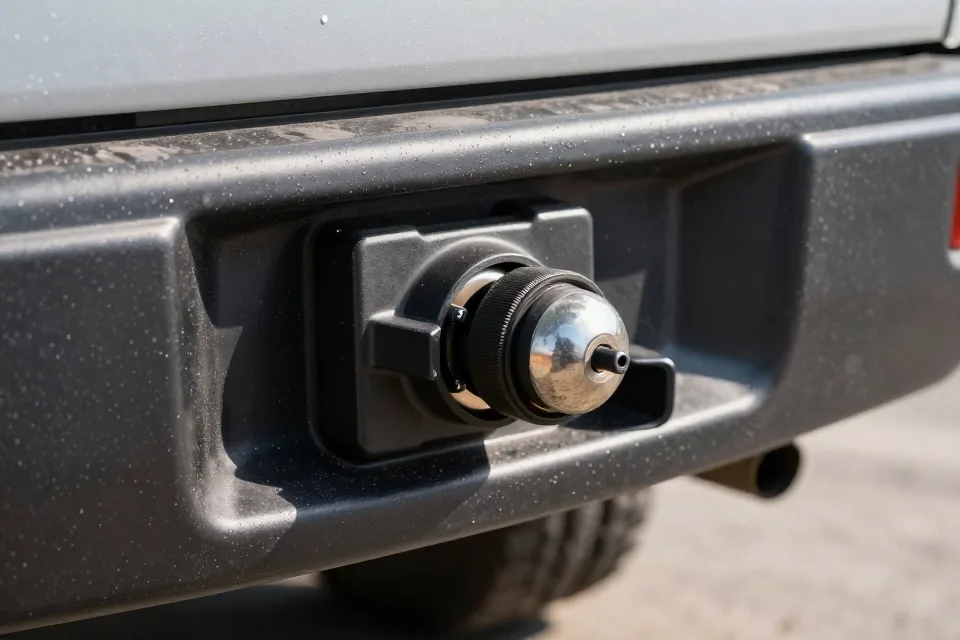
How do you know yours? Weigh the rig. Drive the loaded tow vehicle onto a public scale and get a ticket, then weigh the loaded trailer by itself. The difference between the two numbers is the tongue weight. Weighing once, with the trailer packed exactly the way you travel, beats guessing on every trip afterward.
Watch the stance of the truck when you hitch up. If the rear squats and the front end rides high, a weight-distributing hitch may help. These hitches spread the tongue load across all four wheels of the tow vehicle, a role NHTSA has recognized for load-distributing hitches for decades. Many towing guides suggest considering one when the trailer is heavy — roughly 5,000 pounds or more — or whenever the vehicle sags noticeably.
Load the Trailer the Way It Wants to Be Loaded
NHTSA's trailer-safety guidance boils loading down to a short list: put more weight in the front half of the trailer, strap the cargo down so it cannot shift, and cross the safety chains. Loaded that way, the trailer tracks straight instead of wagging the whole rig.
Keep the heaviest items low and centered, side to side, with roughly 60 percent of the weight ahead of the trailer's axle. A trailer that is heavy at the back lifts its own tongue, cuts tongue weight, and starts to sway at highway speed.
Secure everything, and use the right tools. A shifting load is worse than a heavy load: it changes the tongue weight as you drive and can start a sway that grows until you lose the rig. Ratchet straps for anything that can move — bungee cords are for tarps, not cargo.
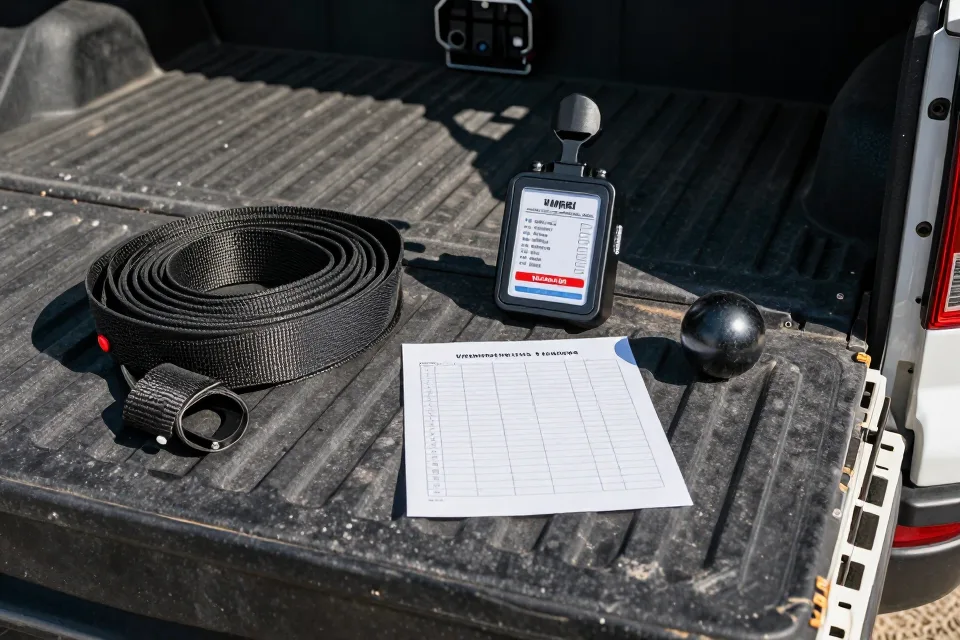
Brakes, Chains, and the Little Black Box
Trailer brake laws are set by each state, and they are not the same everywhere. A common threshold is 3,000 pounds. In Virginia, for example, trailers at or above that weight must have brakes, and trailers that heavy must also carry a breakaway brake device. In Tennessee, brakes are required on one axle for trailers from 1,500 to 3,000 pounds. Check the rules in your own state — and in every state you plan to drive through — before you tow.
If your trailer has electric brakes, the tow vehicle needs a brake controller so you can apply the trailer brakes from the cab. The trailer should also have a breakaway switch: a cable attached to the tow vehicle that pulls a pin if the trailer ever comes loose, letting the trailer's own battery apply the brakes automatically. NAPA's towing guide notes the breakaway system only works if that battery is charged, so it belongs on every pre-trip check.
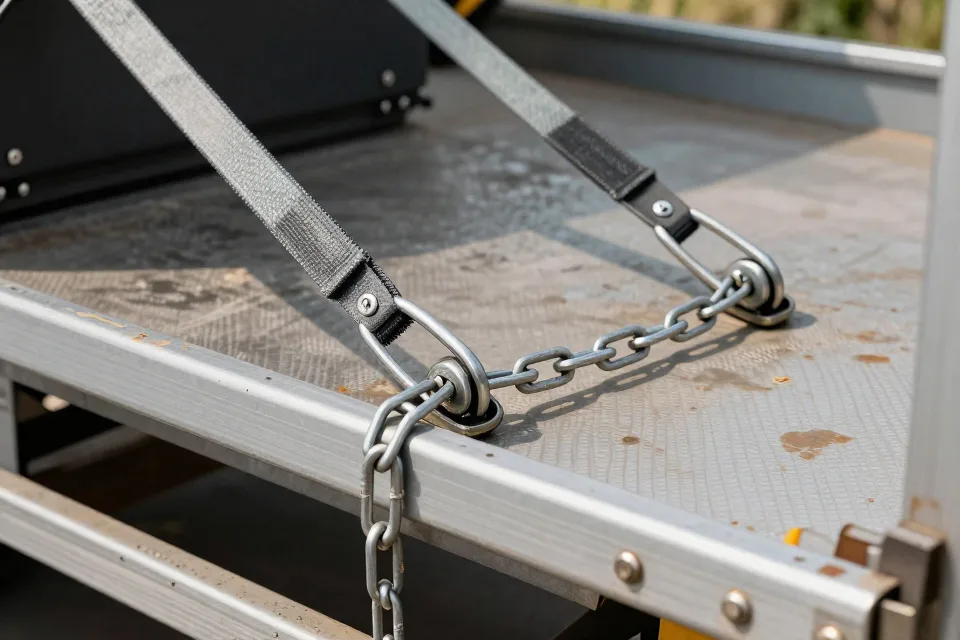
Safety chains are the backup plan, and they only work if you set them up right. Cross them under the coupler in an 'X' pattern, as AAA's Oregon branch advises, so the trailer tongue is cradled if the hitch lets go. Leave enough slack to turn, but attach the chains to solid points on the tow vehicle — never loop them around the ball or the bumper.
Give the breakaway cable its own attachment, separate from the chains, and leave it a little shorter than they are so it does its job before the chains tighten.
Tires: The Part Everyone Forgets
Trailer tires are easy to ignore because they sit out of sight, and that is a mistake. NHTSA names low pressure as the leading cause of tire failure, and tires lose air gradually even without a puncture — trailer tires included.
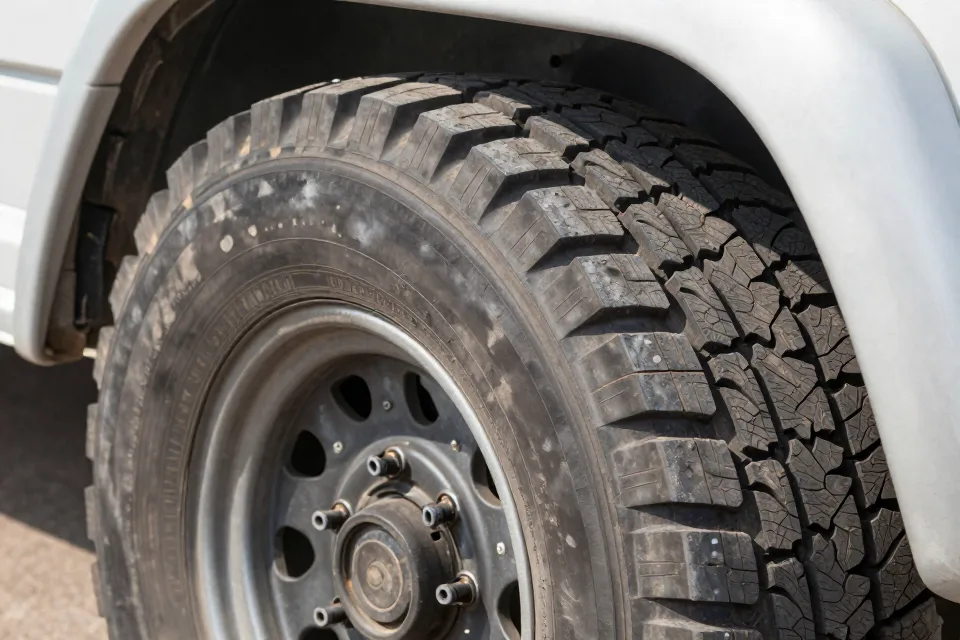
Check tire pressure once a month and before long trips, NHTSA advises, on cold tires — meaning the vehicle has been parked for at least three hours. Use the pressure on the driver's door sticker, not the maximum number molded into the sidewall. Pressure also drifts with temperature, roughly a pound or two for every 10 degrees of change, according to the U.S. Tire Manufacturers Association, so a cold snap can silently lower your numbers.
Trailer tires deserve the same monthly check, with one difference: they typically run near their maximum rated pressure because they work at full load. Confirm the right figure in the trailer's manual or on the tire's sidewall rating, and do not forget the spare. When the tread wears down to 2/32 of an inch — the point where the penny test shows the top of Lincoln's head — replace the tire.
Common First-Time Towing Mistakes
Every one of these is a fixable habit, and together they cause most of the white-knuckle moments on the road:
-
Trusting the towing capacity alone. Payload and tongue weight can bite you long before the trailer reaches the towing limit.
-
Loading to 100 percent of the rating. The ratings assume ideal conditions; leave the 80 percent margin.
-
Skipping trailer brakes or the brake controller to save money. Your truck's brakes alone are not designed to stop a 4,000-pound trailer.
-
Stacking the heavy gear at the back of the trailer. It lifts the tongue, invites sway, and puts the trailer in charge.
-
Treating trailer tires like car tires. They carry near-full loads and need near-full pressure.
-
Hitching up without a test. Lights, brakes, and chains take two minutes with a helper and prevent a roadside surprise.
-
Forgetting that the trailer is behind you. It needs more room to turn, more room to stop, and more room to pass.
How Towing Changes the Way You Drive
Everything you already know about driving still applies — it just needs more room. Brake earlier and more gently, because the rig needs more distance to stop. Take turns wider, because the trailer cuts the corner tighter than the truck. Pass only when you can see well ahead, because acceleration is slower and you need more time to get around.
Some states set lower speed limits for vehicles pulling trailers; California, for example, caps towing at 55 mph even where the posted limit is higher. Where it is legal to go faster, remember that sway builds quickly as speed climbs, so back off when the trailer feels restless.

Plan for worse fuel economy, too. Towing adds both weight and wind drag, and the U.S. Department of Energy notes that an extra 100 pounds in a vehicle can cost about 1 percent of its fuel economy. Proper tire pressure helps offset the loss — the Car Care Council says correct inflation improves gas mileage by more than 3 percent. The practical takeaway: budget extra fuel stops on long hauls.
Backing up deserves practice before you need it. Find an empty parking lot, put your hands low on the wheel, and remember the trailer turns opposite to the steering. A spotter with clear hand signals beats a shouting match at the boat ramp.
Your Pre-Trip Towing Checklist
Run through this list every time you hook up. It takes ten minutes and saves a whole trip:
-
All ratings confirmed: GVWR, GCWR, payload, and tongue weight from the door sticker and manuals
-
Loaded trailer weight within about 80 percent of towing capacity — weighed at a scale at least once
-
Hitch rated for the load; ball size matches the coupler; locking pin in place
-
Tongue weight in the 10 to 15 percent range; the rig sits level
-
Cargo secured, 60 percent in the front half, nothing loose
-
Safety chains crossed and attached to the vehicle; breakaway cable attached separately and shorter than the chains
-
Trailer brakes, brake controller, and breakaway battery checked
-
Lights tested with a helper: turn signals, brake lights, tail lights
-
All tires — vehicle and trailer — checked cold at the right pressure, including the spare
-
Mirrors adjusted for the trailer; chocks within reach for stops
Towing rewards the same habits the road always asks for: patience, planning, and a little arithmetic before you leave the driveway. Learn the numbers, respect the equipment, and the boat, camper, or trailer in your mirrors will follow faithfully for thousands of miles.
The information in this article is general guidance, not a substitute for your vehicle and trailer owner's manuals or the towing laws in your state. For more on how we handle content, see our disclaimer.
Sources
- [authority] https://dmna.ny.gov/nynm/training/NHTSA_TowingSafety.pdf