
What to Do If You Have a Tire Blowout on the Highway
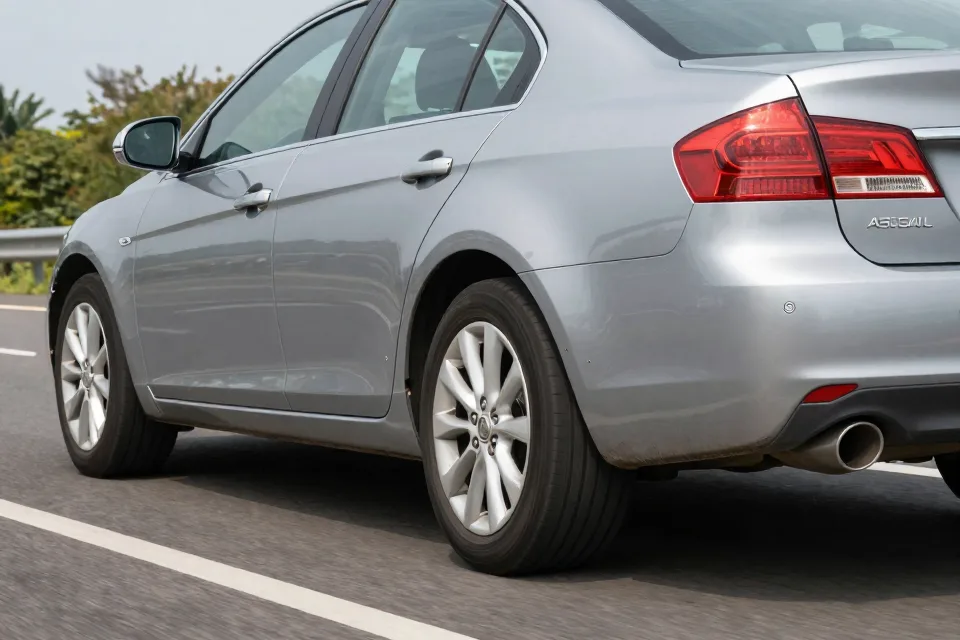
When the Tire Lets Go
A loud bang. A hard pull toward one side. A steering wheel that suddenly feels alive in your hands. Few moments on the highway are scarier, and your instincts will scream one word: brake.
Resist that instinct. A blowout is a rapid loss of air pressure from a tire, and the National Highway Traffic Safety Administration (NHTSA) warns that it can make your vehicle hard to control. Drivers who keep their cool and follow a few simple steps almost always bring the car to a stop without drama. This guide covers the first seconds, the minutes after, and the habits that keep blowouts from happening at all.
What a Blowout Feels Like
You will usually hear a loud pop or bang, and the car may shudder for an instant before it starts to pull. Where you feel the pull depends on which tire failed.
With a front tire, the steering wheel itself tugs hard to one side. With a rear tire, you feel the trouble in the seat and in the body of the car rather than in your hands, and the back end can feel loose. The recovery steps are identical either way — only the sensation differs.
Blowouts are more common than most drivers realize. In the years before tire pressure monitoring systems became standard equipment, NHTSA estimated that flat tires and blowouts were linked to about 78,000 crashes a year, including an estimated 414 deaths and 10,275 injuries. Tires still fail today, which is exactly why knowing the drill matters.
The First Rule: Don't Slam the Brakes
Hard braking is the most dangerous response, and it is also the most natural one. Stomping the pedal shifts the car's weight forward and onto the front tires. On an unbalanced car, that shift makes steering much harder and can turn a controllable situation into a spin.
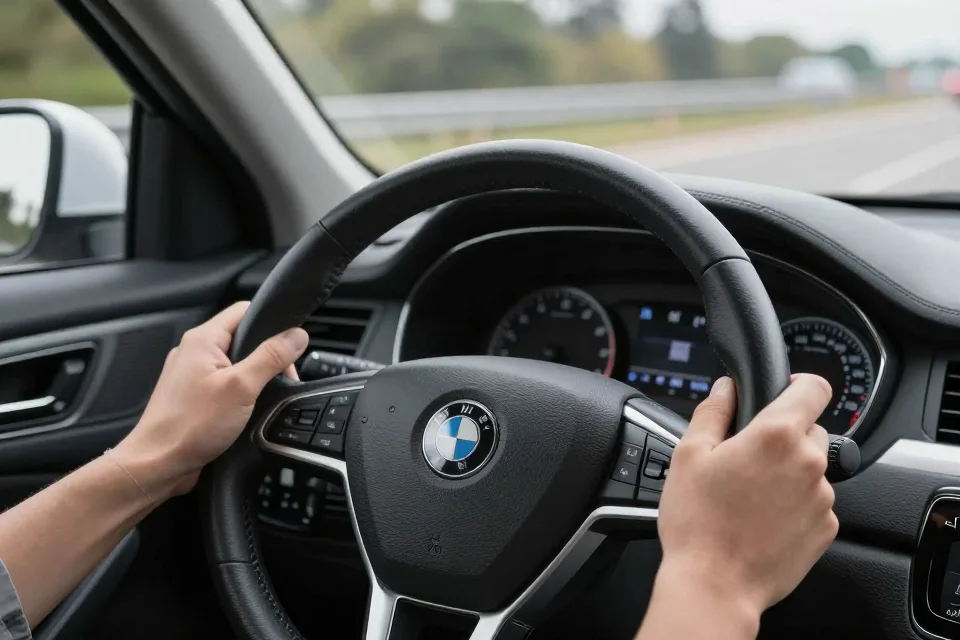
Your first job is to hold the wheel. NHTSA advises gripping the steering wheel firmly with both hands — the 9 and 3 o'clock positions give you the most leverage — and keeping the car pointed as straight as you can. Do not jerk the wheel, even though the car wants to pull.
Next, ease off the accelerator gradually. No sudden moves, no aggressive downshifting. The drag of the ruined tire and the engine's own slowing will bleed off speed on their own. In the first seconds, your only goal is to stay in your lane.
What to Do, Step by Step
Once the car is settled, work through these steps in order:
-
Grip the wheel firmly with both hands and steer to hold a straight line.
-
Ease off the gas slowly. Do not brake hard.
-
Let the car slow itself; a blown tire creates heavy drag.
-
When speed has dropped to a safe level, brake gently with light, steady pressure.
-
Turn on your turn signal, check mirrors and blind spots, and steer toward the right shoulder or the nearest safe area.
-
Pull completely off the road, as far from traffic as you can manage.
-
Turn on your hazard flashers, set the parking brake, and call for help.
The same sequence works for a front blowout and a rear blowout. The difference is only in what you feel, never in what you do.
After You Stop: Getting Off the Roadway Safely
Stopping does not mean you are safe. The shoulder is still part of the highway, and traffic is passing close by at speed.
Keep your hazard flashers on, and if you carry reflective triangles or flares, place them well behind your car — but only if you can do so safely. On a narrow or busy shoulder, your best move is usually to stay in the vehicle with your seat belt on and call for help rather than stand beside the traffic. AAA advises keeping the car as far off the road as possible and staying alert; if you must get out, use the door on the side away from traffic and keep watching for approaching vehicles.
Do not assume other drivers will see you. Every state now has a move-over law that requires drivers to shift over or slow down when passing a stopped vehicle with flashers on, but not everyone obeys. Treat every passing car as a hazard.
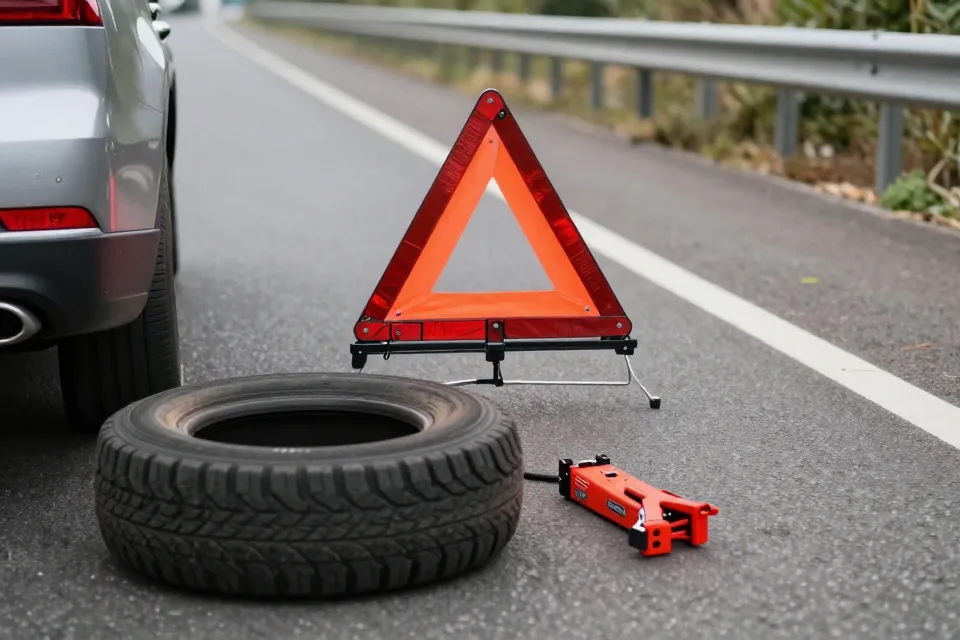
One more honest word: changing a tire on a highway shoulder is often more dangerous than waiting. On a busy interstate, call roadside assistance and let a professional do the swap somewhere safer.
Common Mistakes Drivers Make
| Wrong move | Why it backfires | Do this instead |
|---|---|---|
| Slamming the brakes | Weight shifts forward and steering gets much harder | Ease off the gas; brake gently once you are slow |
| Jerking the wheel against the pull | Can whip you into another lane or a spin | Steer firmly with smooth, small corrections |
| Stopping in the travel lane | You become a sitting target for traffic | Keep rolling to the shoulder if you can |
| Jumping out on the traffic side | Standing beside moving cars is deadly | Exit away from traffic, or stay belted inside |
| Changing the tire on the shoulder | Too exposed on a high-speed road | Call roadside assistance unless you have a safe spot |
| Driving on the ruined tire to "make it home" | Ruins the wheel and puts everyone at risk | Pull over at the first safe place |
| Ignoring early warning signs | Vibration, thumping, or a TPMS light usually mean a tire is failing | Check tires before the blowout happens |
Why Tires Blow Out in the First Place
Most blowouts are not random bad luck. They are the end point of a problem that built up over time.
Underinflation is the biggest culprit. A soft tire flexes more as it rolls, and that flexing builds heat. NHTSA's crash research found that tires underinflated by more than 25 percent were significantly more likely to play a role in a crash, and the agency notes that low pressure creates heat that can lead to rapid tire wear and failure. The National Safety Council says the same: underinflated tires can directly lead to blowouts.
Heat itself is another ingredient. Hot pavement, highway speeds, and a heavily loaded car all push tire temperatures up. A tire that is already weak — from age, damage, or low air — can give out.
Road damage counts too. A hard curb strike or a pothole can bruise the sidewall, and a damaged sidewall threatens the whole structure of the tire. Tires with sidewall damage need to be replaced, not patched.
Age is the quiet one. Rubber hardens and weakens over time even when the tread still looks fine. Safety experts recommend replacing tires once they reach roughly six to ten years old, no matter how much tread remains.
Preventing a Blowout: The Monthly 5-Minute Check
You can cut your odds of a blowout dramatically with a short monthly routine. NHTSA recommends giving your tires a pressure check at least once a month and before long trips.
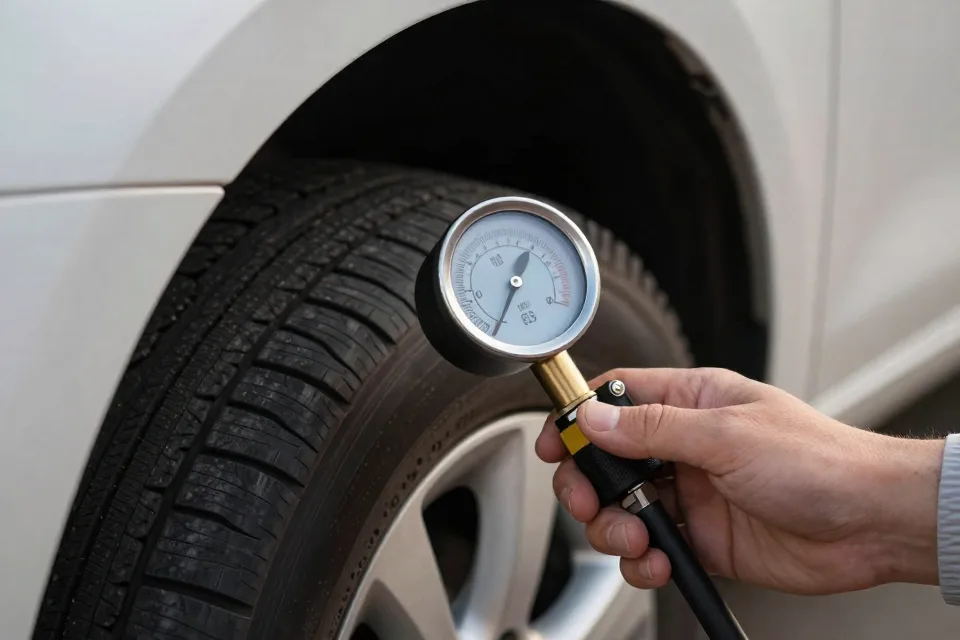
Check when the tires are cold — first thing in the morning, before driving. Fill each tire to the cold inflation pressure printed on the sticker inside the driver's door, not to the number molded into the tire's sidewall.
If your car has a tire pressure monitoring system (TPMS), take the warning light seriously. Federal rules have required TPMS on every new light vehicle since the 2008 model year, and the light is designed to come on when pressure drops about 25 percent below the recommended level. A steady light means at least one tire is low — check all four.
Tread matters as much as air. The penny test is a quick check: slide a penny into a tread groove with Lincoln's head pointing down. If you can see the top of his head, the tread is worn to about 2/32 of an inch and the tire is at the end of its life.
Finally, check the calendar, not just the tread. The DOT date code molded into the sidewall tells you the week and year the tire was made. If your tires are closing in on six years, start planning their replacement.
If You Must Use the Spare
Many cars carry a compact temporary spare, sometimes called a donut. It is a get-you-to-the-shop tire, not a real replacement. Most temporary spares are rated for about 50 miles of driving at speeds no higher than 50 mph — and the exact limits are in your owner's manual, so check yours.
After mounting the spare, drive straight to a tire shop and have the damaged tire inspected or replaced. Check the spare's pressure too; a donut that has sat in the trunk for years can be flat when you finally need it. And confirm your car actually has one — some newer vehicles skip the spare and carry a sealant kit instead.
The Takeaway Checklist
When the tire blows:
-
Grip the wheel with both hands and steer straight.
-
Keep your foot off the brake until the car slows.
-
Ease off the gas gradually and let the drag slow you down.
-
Brake lightly once you are slow, signal, and head for the shoulder.
-
Stop as far off the road as possible and turn on your flashers.
-
Stay belted in, or exit on the side away from traffic; call for help.
-
Use the spare only within its limits, and only in a safe spot.
Before the tire blows:
-
Check pressure monthly, when cold, to the door-sticker numbers.
-
Take the TPMS light seriously — low pressure is the top warning.
-
Penny-test the tread; replace tires at 2/32 of an inch.
-
Replace tires by six to ten years old, no matter the tread.
-
Replace any tire with a damaged sidewall.
A few minutes of prevention each month is a small price for keeping a blowout off your list of highway emergencies.
This article is general information for everyday drivers and is not a substitute for your owner's manual or a qualified technician. See our full disclaimer.
Sources
- [authority] https://www.nhtsa.gov/vehicle-safety/tires