
Car Loans Explained: APR, Terms, and What You're Really Paying
The number on the whiteboard is not the deal
Very few drivers pay cash for a car. The average new vehicle now sells for right around $50,000, and for most households that means a loan. The figure that gets the most attention is the monthly payment — the one the salesperson writes on the whiteboard. But that number hides almost everything that matters. Two different loans can carry the same monthly payment and still cost you thousands of dollars apart by the time the last check is written.
This guide walks through what APR really means, how lenders decide what to charge you, why loan length changes the math, and what to look at before you sign anything.
Every car loan is three numbers
Strip away the jargon and every auto loan comes down to three numbers: how much you borrow (the principal), what that money costs (the interest rate and the APR), and how long you have to pay it back (the term, in months). The monthly payment is simply the result of those three numbers working together. Focus on any one of them and you are only seeing part of the deal.
The Consumer Financial Protection Bureau (CFPB) lays out the vocabulary: the principal is the amount you finance, interest is the charge for borrowing it, the finance charge is the interest plus certain fees, and the total of payments is the principal plus the finance charge. That last figure — the total of payments — is the real number that comes out of your pocket.
Interest rate vs. APR: why the difference matters
Two lenders can advertise the same interest rate and still charge you different amounts, which is why the APR exists. The interest rate is the annual percentage charged on the amount you borrow. The APR — annual percentage rate — includes the interest plus many of the fees and other costs attached to the loan. Because the APR bundles those costs together, it gives you a truer apples-to-apples number when you compare one offer against another. When two loans sit side by side, compare APR, not just the rate.
For a sense of the market: the average APR on a new-car loan was roughly 7% in early 2025, and roughly 11% on a used-car loan, according to Experian's State of the Automotive Finance Market report. Your own quote will be different — it depends on the factors below.
What lenders look at when they price your loan
Lenders do not pull a rate out of a hat. The CFPB says they weigh a handful of things: your credit history and credit scores, your income, your existing debts, the size of your down payment, the amount you borrow, the length of the loan, and the age of the vehicle. More perceived risk on any of those fronts usually means a higher rate.
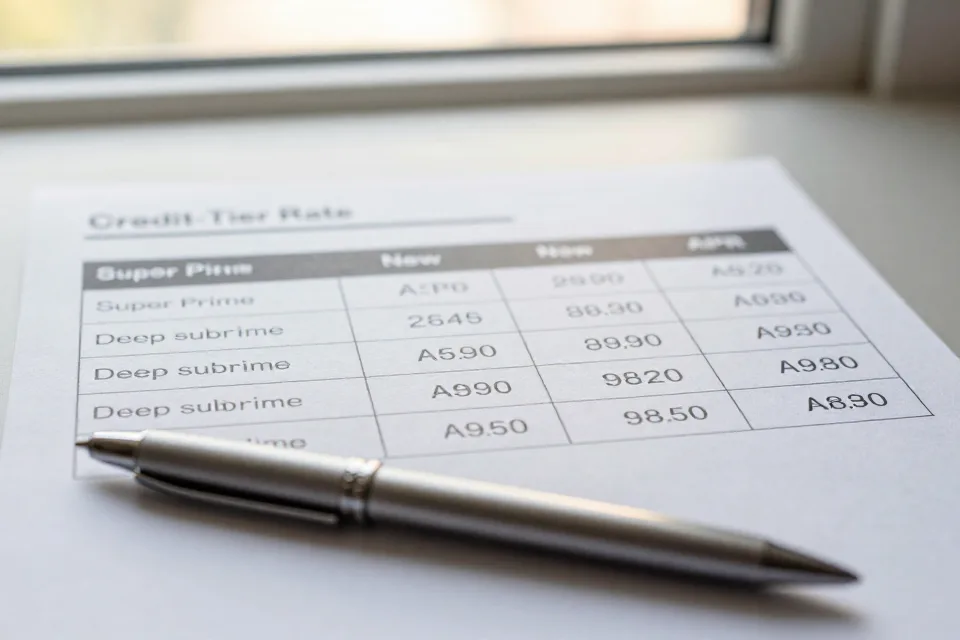
Credit scores get the most attention, for good reason. Experian groups borrowers into tiers — super prime (781–850), prime (661–780), nonprime (601–660), subprime (501–600), and deep subprime (300–500) — and recent Experian data shows rates climbing steadily from one tier to the next. Borrowers at the top have seen new-car APRs in the low single digits in recent quarters, while deep-subprime borrowers have been quoted rates in the mid-teens on new cars and around 20% on used cars. Used-car loans almost always cost more than new-car loans, because the car itself is worth less as collateral.
Typical recent averages reported by Experian (rounded; rates change and your offer will differ):
| Credit tier | Typical new-car APR | Typical used-car APR |
|---|---|---|
| Super prime (781–850) | roughly 6% | roughly 8% |
| Prime (661–780) | roughly 7% | roughly 10% |
| Nonprime (601–660) | roughly 9% | roughly 13% |
| Subprime (501–600) | roughly 12% | roughly 16% |
| Deep subprime (300–500) | roughly 14% | roughly 20% |
Small differences in APR add up fast. As a rough example: on a $35,000 five-year loan, every additional point of APR adds roughly $1,000 in interest over the term. That is simple arithmetic on published rates, not a quote from any lender — but it shows why the rate deserves your attention.
How long should your loan run?
Loan terms have been creeping up for years. The average new-car loan now runs about 70 months — nearly six years — according to Experian. A growing number of buyers go even longer: a record 22.4% of new-car buyers chose seven-year (84-month) loans in late 2025, according to industry data.
Why the drift? Longer terms shrink the monthly payment, and with the average new-car payment near $750 a month in the third quarter of 2025, that is tempting. But the trade-off is real. Edmunds recommends keeping a new-car loan to 60 months or less, because cars depreciate faster than loan balances shrink. On a long loan, it is easy to reach a point where you owe more than the car is worth — what lenders call negative equity, or being upside down.
The numbers show how common that is. Edmunds data found the average upside-down borrower owed about $6,905 more than their trade-in was worth — an all-time high — and roughly one in four new-car trade-ins is now underwater.
A shorter term means a higher monthly payment but far less total interest, and you own the car outright sooner. The right length balances what you can afford each month against how much interest you are willing to pay over the life of the loan.
Down payments and trade-ins
The down payment is your first lever. A bigger down payment means a smaller loan, and lenders tend to view it as a sign of lower risk — the CFPB lists it among the factors that shape your rate. Yet in the third quarter of 2025, average down payments on new cars fell to near a four-year low, according to Edmunds, as buyers stretched to afford higher prices.
The trade-in is the second lever — and the one that trips up many people. If you are trading in a car with an outstanding loan, the dealer pays off that balance first. Whatever the loan exceeds the car's value — the negative equity — usually gets rolled into your new loan. That means you can end up financing a car you no longer drive. Know your trade-in's value and your exact payoff amount before you walk in, and ask directly how much, if anything, is being added to the new loan.
Common mistakes car buyers make
-
Shopping by monthly payment alone. The payment is the output, not the deal. Two lenders can quote the same payment with very different totals. Ask for the APR, the term, and the total of payments.
-
Stretching the term to afford the payment. A 72- or 84-month loan can look great on paper and still leave you upside down for years. The average new-car loan is already near 70 months, and the record share of seven-year loans shows how common the trap has become.
-
Comparing interest rates but ignoring the APR. The rate does not include the fees that the APR does, so a lower rate can be the more expensive loan.
-
Financing add-ons into the loan. Extended warranties, paint protection, GAP coverage — each one is rolled into the principal and earns interest for the life of the loan. The FTC's Combating Auto Retail Scams (CARS) Rule, in force since July 30, 2024, bans dealers from charging for add-ons you did not agree to and from presenting them as required. Decide which extras you actually want before you sit down in the finance office.
-
Skipping pre-approval. Getting a rate from a bank or credit union before you shop gives you a number to beat and keeps the dealer honest.
-
Signing without reading the disclosure. The Truth-in-Lending disclosure spells out the APR, the finance charge, and the total of payments. If the total is a surprise, that is the moment to ask questions — not after you drive away.
Where the loan comes from: dealer, bank, or credit union
Most new cars are financed, and the loan can come from a bank, a credit union, the manufacturer's finance arm, or the dealer's own finance company. The advice from Cars.com: get pre-approved before you shop, then compare the dealer's offer against that pre-approval.
Sometimes dealer financing wins. Manufacturers run special offers, including 0% APR deals. But Edmunds notes those offers usually require top-tier credit, and you may have to give up a cash rebate to get the low rate. Read the fine print: a 0% number only helps if it truly produces the lowest total cost.
One more habit of careful shoppers: negotiate the price of the car and the terms of the loan separately. If the dealer is marking up your rate to earn a commission — a practice the FTC has targeted — you will not see it unless you are comparing against an offer you already hold.
Paperwork: the Truth-in-Lending disclosure
Before you sign, the lender must give you a Truth-in-Lending disclosure. The CFPB explains that this form states the APR, the finance charge, the total of payments, and the payment schedule in plain dollars and cents. Take the time to read it. The finance office is designed to move fast; nothing in the law says you cannot slow down.
The CFPB also warns against letting anyone rush you into add-ons you have not reviewed. Every yes in the finance office adds to the principal and grows with interest. If an item was not discussed or you do not understand it, say so.
What if the dealer calls you back?
Sometimes a dealer lets you take the car home before the financing is final — a practice called spot delivery. If the lender later declines the deal or demands a higher rate, the dealer may call you back to re-sign. The CFPB's guidance is straightforward: know the terms before you drive off, get everything in writing, and understand what the contract says about the dealer's right to change the deal. If the new terms are worse, you are not stuck — but the details matter, so read the contract and ask questions before anything is re-signed.
Before you sign: a checklist
-
Confirm the APR, the term, and the monthly payment in writing.
-
Find the total of payments on the Truth-in-Lending disclosure — that is what the car really costs.
-
Compare at least two financing offers.
-
Decide which add-ons, if any, you want before you enter the finance office.
-
Check your credit report and know your credit score before you shop.
-
Get your trade-in's value and payoff balance in writing.
-
Never sign a form with blank spaces.
-
If the deal changes after you drive home, review it carefully before agreeing to anything new.
The bottom line
A car loan is a simple machine: principal, APR, and term. But the numbers only help if you look at all three together, plus the total they add up to. The average payment gets the headlines; the total of payments is what comes out of your pocket. Taking an extra hour to compare offers, read the disclosure, and check the fine print is the cheapest insurance you can buy.
This article is for general information only and is not financial, legal, or tax advice. Please see our disclaimer for more.
Sources
- [authority] https://www.consumerfinance.gov/ask-cfpb/what-is-the-difference-between-a-loan-interest-rate-and-the-apr-en-733/