
Roundabouts: How to Drive Them Confidently
Why Roundabouts Make Good Drivers Nervous
If you learned to drive before 1990, nobody ever taught you how to use a roundabout — because the United States did not get its first modern ones until that year, when several were built in Nevada. For a long time they were rare enough to avoid. Not anymore. The country now has well over eight thousand of them, and the count keeps climbing, so chances are good you will meet one on the way to the store, the doctor's office, or a grandchild's game.
The good news: a roundabout is one of the simplest intersections on the road once you grasp three things — traffic in the circle comes first, pick your lane early, and keep moving. This guide walks through each one in plain English, plus the mistakes that trip up even experienced drivers.
A Circle With a Job to Do
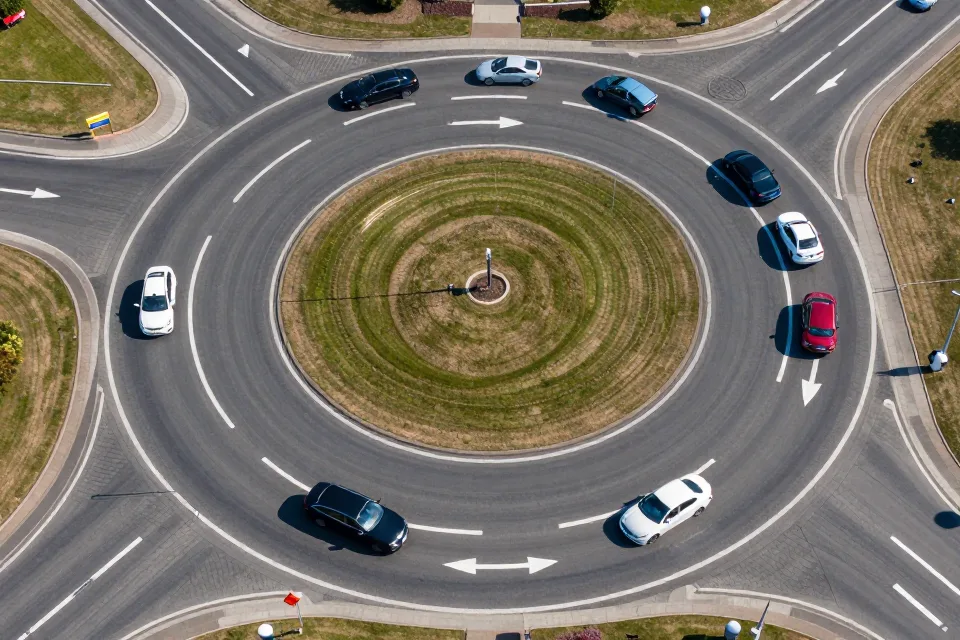
A roundabout is a circular intersection with a raised island in the middle. Traffic moves one way around the island — counterclockwise in the United States — and there are no stop signs or traffic lights to puzzle through. Drivers slow down, look for a gap, and merge, the same way they would when joining a road from a driveway.
Engineers push for roundabouts because intersections are the danger spots on American roads. Federal Highway Administration figures show that intersection-related crashes have made up more than 45 percent of all crashes nationwide. Roundabouts attack that problem by forcing low speeds and removing the worst collision angles — the high-speed head-on and right-angle hits you get at a traditional crossing.
Those changes add up on paper and on the road. In a widely cited 2000 study of 24 intersections converted to roundabouts, total crashes fell 39 percent, injury crashes fell 76 percent, and crashes involving fatal or incapacitating injuries fell 90 percent. The Insurance Institute for Highway Safety (IIHS) reports similar results from later conversions: injury crashes dropped 72 to 80 percent, and all crashes dropped 35 to 47 percent.
The Golden Rule: Traffic in the Circle Comes First
If you remember only one rule, make it this: the traffic already moving around the circle has the right of way. Every car entering must yield — every time, no exceptions. Because traffic flows counterclockwise, circulating cars reach you from the left, so that is where your eyes should go as you near the entry.
If the circle is empty, you do not have to stop; you may roll in when you can see it is clear. AARP's driving experts describe the entry as being like a right turn on red: stop only if you must, look, and go when it is safe.
In a multi-lane roundabout, the rule gets stricter: you must yield to traffic in every circulating lane, not just the lane closest to you. A car two lanes over can reach your entry point a second later, and it still has the right of way over you.
How to Drive a Single-Lane Roundabout
Single-lane circles are where most drivers learn the routine. Here it is, step by step:
-
Slow down as you approach — typically to 15 to 25 mph, the speed these intersections are designed around. Watch for the yellow roundabout-ahead sign and its advisory speed.
-
Check the crosswalk at the entry. Pedestrians have the right of way there, so be ready to stop for anyone crossing or waiting to cross.
-
At the dashed yield line, look left. Yield to cars already circulating, then move in when there is a safe gap. If the circle is clear, enter without stopping.
-
Hold a slow, steady speed once you are in. Stay to the right of the central island and follow the curve. No stopping, no passing, no lane changes.
-
Signal right as you pass the exit before yours. That tells drivers waiting at the next entry that you are leaving the circle.
-
Check the exit crosswalk for pedestrians, then ease out. You normally do not need to brake hard to leave — just roll out smoothly.
One more habit worth building: do not come to a full stop at the yield line unless you have to. A driver who stops on an empty circle confuses everyone behind and invites a rear-end bump.
Multi-Lane Roundabouts: Decide Before You Get There
The single biggest difference at a two- or three-lane roundabout is lane choice, and you make it before you enter — the same way you would at any intersection. Follow the signs and pavement arrows, but the general pattern is: the right lane for turning right, the left lane for turning left or making a U-turn, and either lane for going straight unless markings say otherwise.
Pick your lane, then yield to both circulating lanes before you move in. Do not change lanes inside the circle, and do not pass another vehicle. If you find yourself in the wrong lane, the safest fix is to go around the circle once and exit where you can correct your route — one extra loop beats a sideswipe.
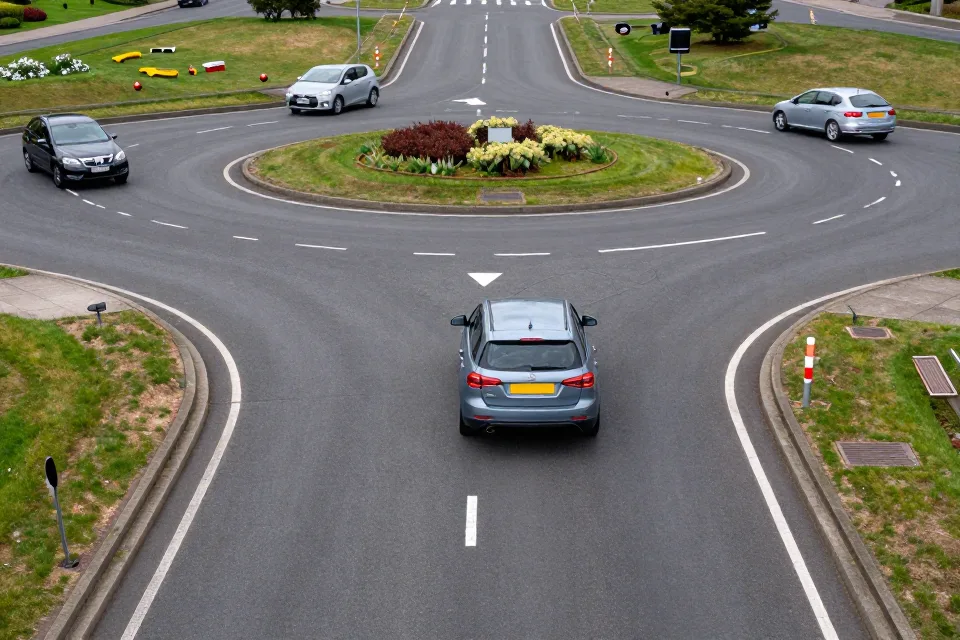
If two-lane circles still feel intimidating, you are in good company, and the data says you will adjust. A 2019 IIHS study of two-lane roundabouts in Washington state found that crashes fell about 9 percent per year as drivers grew familiar with them.
Sharing the Circle: Pedestrians, Cyclists, and Big Rigs
Roundabouts are built for people on foot, on bikes, and in cars, and every one of those users has a claim to the space.
Pedestrians. Yield at the entry crosswalk and again at the exit crosswalk — the exit is where drivers tend to relax. And remember that a pedestrian using a white cane or a guide dog has the right of way at all times, so take extra care when turning or exiting.
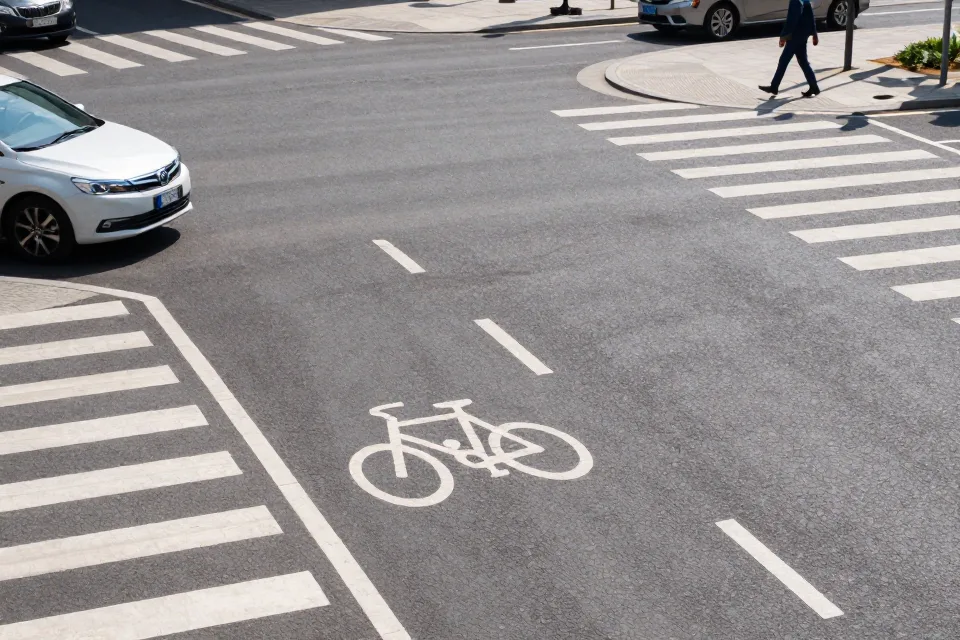
Cyclists. Some ride in the lane with cars and some use the crosswalks. Yield to them either way.
Trucks and buses. A big rig needs a lot of room to sweep through the curve, and its rear wheels cut much closer to the island than the cab does. Give large vehicles extra space and never drive alongside one inside the circle — hang back and let it finish the turn.
Common Roundabout Mistakes and How to Avoid Them
Most roundabout trouble comes from a short list of repeatable errors. Each one has an easy fix:
-
Stopping on an empty circle. Fix: if you can see the circle is clear, keep rolling through.
-
Entering without yielding. Fix: wait for a real gap, not a maybe-gap.
-
Checking only the nearest lane. Fix: sweep your eyes across every circulating lane before you move.
-
Changing lanes mid-circle to chase a missed exit. Fix: go around again. It is safer and often faster.
-
Forgetting the exit signal. Fix: signal right as you pass the exit before yours.
-
Following the car ahead too closely. Fix: keep at least a car length of space — rear-end bumps are among the most common crashes at roundabouts.
-
Honking at a nervous driver at the yield line. Fix: patience. Pressure makes hesitant drivers do something sudden.
Do Roundabouts Really Save Lives?
Yes — and the evidence is among the strongest in traffic safety. The Federal Highway Administration lists roundabouts as a proven safety countermeasure. The reason comes down to physics: at low speed with shallow angles, the crashes that do happen are far less severe, and drivers have more time to spot pedestrians and cyclists.
Here is what the research shows:
-
A 2000 study of 24 converted intersections: 39 percent fewer crashes, 76 percent fewer injury crashes, and 90 percent fewer fatal or incapacitating crashes.
-
IIHS studies of intersections switched from stop signs or signals to roundabouts: injury crashes down 72 to 80 percent, all crashes down 35 to 47 percent.
-
A study of 19 rural intersections with speed limits of 40 mph or higher: 62 percent fewer crashes and 85 percent fewer injury crashes after roundabouts replaced stop signs.
The crashes that still occur tend to be low-speed ones — cars entering and exiting the circle, and rear-end bumps. Those are rarely severe, which is exactly the point.
When an Emergency Vehicle Shows Up
Fire trucks, ambulances, and police cruisers have the right of way — that is the law. If one approaches while you are in the circle, do not stop in the middle of the road. Take your exit, then pull over as soon as you safely can and let it pass. If you are still waiting to enter, hold at the yield line and let the emergency vehicle go around first.
Your Roundabout Checklist
Keep this in your head and every circle on your route gets easier:
-
Slow down as you approach
-
Choose your lane before you enter
-
Look left and yield to every lane of circulating traffic
-
Enter when there is a real gap; roll on through if the circle is empty
-
Stay in your lane — no stopping, no passing, no lane changes
-
Signal right as you pass the exit before yours
-
Check the exit crosswalk for pedestrians
-
Give trucks, buses, and bikes extra room
-
Clear the circle for emergency vehicles, then pull over
-
Remember: one extra loop is always safer than one risky move
Roundabouts look unfamiliar, but they reward calm, patient driving. Slow down, yield, signal, and keep moving — and you will handle every circle on your route with confidence.
The information in this article is general guidance for drivers, not a substitute for the traffic laws or driver manual in your state. For more on how we handle content, see our disclaimer.

Sources
- [authority] https://www.iihs.org/research-areas/roundabouts