
Dead Key Fob? What to Do and How to Fix It
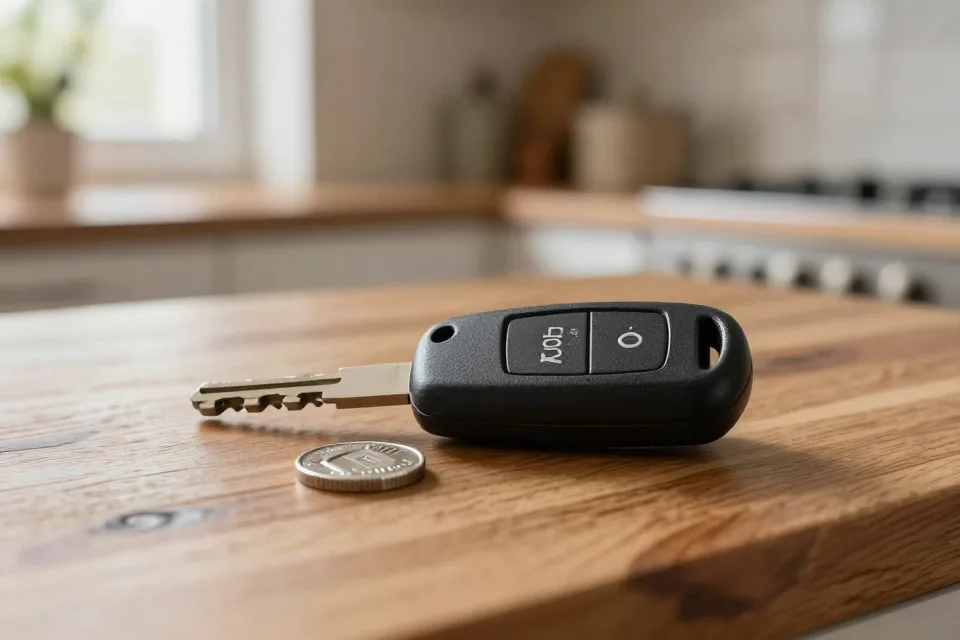
Every driver meets this moment sooner or later. You stand beside your car, press the unlock button on the key fob, and nothing happens. You press again, walk closer, hold the fob higher — still nothing. Before you panic or call a tow truck, take a breath. A dead key fob is one of the most common, and most fixable, car annoyances there is.
A key fob runs on a small coin-shaped battery that wears out like any other battery. The good news: you can usually still get into your car, start it, and drive away in minutes. The permanent fix — a fresh battery — costs about as much as a coffee. This guide covers the warning signs, the workarounds, and the five-minute repair.
1. The first signs of a dying key fob battery
Fob batteries fade slowly, and your car usually drops hints before the fob quits entirely. Watch for these clues:
-
Shorter range. You used to unlock the car from across the lot. Now you have to walk right up to the door before the buttons respond.
-
Repeated presses. The doors unlock on the third try, or the trunk pops a beat after you hit the button.
-
A dashboard warning. Many newer cars show a message like 'key fob battery low' when the fob's power drops.
-
Push-button trouble. The car starts only when you hold the fob right against the start button, instead of from your pocket.
-
A dim or dead LED. If your fob has a small light that no longer flashes when you press a button, the battery is likely on its way out.
With everyday use, most fob batteries last roughly two to four years. Fobs that stay in constant contact with the car — the kind that unlock as you reach for the handle — use more power and may need a new cell sooner. When you spot the first signs, plan to swap the battery within a week or two. A coin cell is cheap insurance against a stranded evening.
2. Quick checks before you panic
If the fob suddenly stops working, spend two minutes ruling out the easy stuff before you take anything apart.
-
Try your second fob. If the spare works, the problem is the first fob or its battery, not the car.
-
Look at the whole car. If the interior lights are dead and the doors feel sluggish, the car's own 12-volt battery may be the real problem. If both fobs fail, the trouble may be in the car's receiver or in the fob's programming.
-
Find the battery code. The type is printed right on the battery face, and most owner's manuals list it as well. Knowing the code before you shop saves a second trip.
-
Check the owner's manual. It shows where the backup key hides, where to hold the fob to start the car, and how to open the case on your exact model.
3. Locked out? Find the hidden key
Every key fob for a car with remote entry includes a physical key, usually tucked inside the fob itself. Look for a small release button or latch on the side or back; press it and the blade slides out.
Where that key goes depends on your car. Some models have a traditional keyhole in the door handle, while others hide it behind a small cover. In a push-button car, the key may open the door but not start the engine — that is normal, and starting is covered next.
The golden rule: do not force anything. If the blade will not slide out or the cover will not lift, the owner's manual shows the trick. Practicing this once at home, in daylight, is worth far more than learning it in a dark parking lot.
4. How to start a push-button car with a dead fob
Here is the secret most drivers never learn until they are stuck: you usually do not need a working fob battery to start the car. When you hold the fob in the right spot, the car can still read the chip inside it — the battery mainly powers the radio buttons.
The usual trick is to press the brake pedal and hold the dead fob directly against the START button while you press it. Some cars instead have a marked spot in the center console or a special pocket in the cup holder. Your owner's manual names the exact location.
Every car is a little different, so check the manual before you are in a hurry. Try the no-battery trick at home sometime — it takes ten seconds and can save your evening.
5. Replace the battery yourself in about five minutes
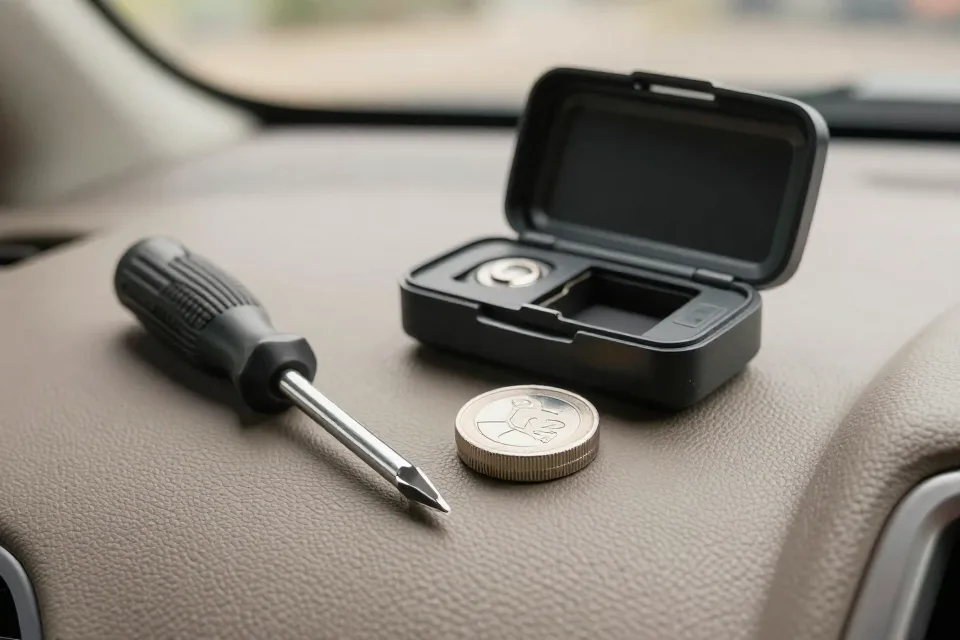
Swapping the cell is one of the simplest jobs on a modern car. A replacement battery usually costs about $10 or less, and you need no special tools beyond a small flat-head screwdriver or a coin.
-
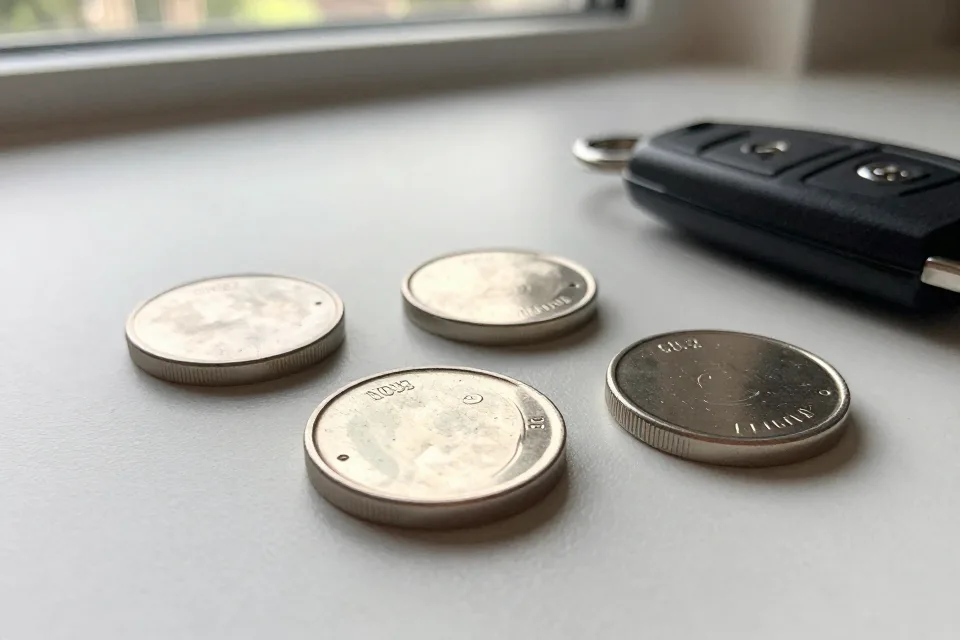
Get the right battery. The code is printed on the old cell. CR2032 is the most common size; other frequent types include CR2025, CR2016, CR2450, CR1616, and CR1620. If you are unsure, the owner's manual or a parts store lookup will settle it.
-
Open the case gently. Most fobs split along a seam, often at a small notch. Work a coin or the screwdriver into the notch and twist gently. If your fob has a hidden key, remove it first — it often hides a screw or clip.
-
Note the orientation. Look at which side of the old battery faces up before you lift it out. The new cell must sit the same way, or the fob will stay dead.
-
Handle the new battery by its edges. Oils from your fingers on the flat faces can weaken the connection. If the old cell left white crust or residue behind, wipe the contacts gently with a soft cloth.
-
Snap it shut and test. Close the case until it clicks, then try every button from a few paces away. Walk back to the car and confirm the doors, trunk, and start all respond.
In most cars, replacing the battery does not require any reprogramming. If the fob still does nothing with a fresh cell, move on to the next section.
6. When a new battery isn't the answer
A fresh battery fixes most fobs, but not all. If yours stays silent, the issue may be something else:
-
A lost connection. Some cars need the fob re-synced or reprogrammed after the battery has been out for a while. The owner's manual or a dealer can walk you through it.
-
Dirty or worn contacts. The metal fingers that touch the battery can bend, corrode, or simply wear out over years of use.
-
Damage. A fob that has been dropped, soaked, or left in the sun can have a cracked circuit board that no battery will revive.
-
A dead fob entirely. If reprogramming does not help, you may need a replacement. New fobs are not cheap, and programming them adds more, so check your warranty or roadside assistance plan before you pay out of pocket.
A locksmith or dealer can usually handle the programming. Before you spend anything, ask for a price in writing — quotes vary a lot.
7. Common mistakes even careful drivers make
These are the fob mistakes we see most often:
| Mistake | Why it bites | Do this instead |
| --- | --- | --- |
| Waiting until the fob dies completely | You get stranded with no warning | Replace the cell at the first sign, or every couple of years |
| Buying the wrong battery code | It won't fit or won't power the fob | Read the code printed on the old battery |
| Installing the new cell upside down | The fob stays dead with a fresh battery | Copy the old battery's orientation exactly |
| Prying hard at the seam | A cracked case can ruin the fob | Use a coin or small screwdriver and check the manual |
| Touching the battery's flat faces | Skin oils can weaken the connection | Handle the cell by its edges |
| Ignoring the low-battery warning | It fails at the worst possible moment | Swap the battery within a week |
| Never practicing the hidden key | You fumble in the dark when it counts | Try the backup key once, at home |
| Warming the car up in a closed garage | Carbon monoxide can build up fast | Open the garage door or move the car outside first |
8. Remote start, idling, and a word about carbon monoxide
Keyless ignition is convenient, but it comes with a danger many owners never think about: it is easy to leave the engine running by accident. NHTSA warns that drivers can walk away with the engine still on, and a car running in a closed garage can fill the space with carbon monoxide — a gas with no color and no smell.
The CDC's guidance is blunt: don't run a car engine in a garage connected to the house, even if the door is open. If you warm up the car in winter, back it out first. A running engine in any enclosed space is a risk to everyone inside the home.
Idling also wastes fuel for no reason. The car is not moving, so it is covering zero miles while it sits, and research shows that letting the engine sit at idle for more than ten seconds burns more fuel than switching it off and starting again. Depending on the engine, a full hour of idling can burn roughly a quarter to half a gallon of gas. If you use a phone app to remote-start the car, use it while the car is outside — never in the garage.
9. Your two-minute key fob checklist
-
I know the battery code my fob uses (check the old cell or the manual).
-
I have a spare battery of the right type at home or in the glovebox.
-
I know how to release the hidden key and where the door keyhole is.
-
I know where to hold my fob to start the car without battery power.
-
I replaced the battery within the last couple of years, or at the first warning sign.
-
I tested both fobs after the last battery change.
-
Spare coin batteries are stored out of reach of small children.
-
I never warm up the car inside a closed garage.
Keep your keys working for the road ahead
A key fob battery is one of the cheapest and easiest fixes on any modern car. Ten minutes of preparation — a spare cell, a quick practice with the hidden key, and one battery swap — can keep you from ever standing in a parking lot pressing a button that will not answer.
This article is for general information only and is not a substitute for your owner's manual or a qualified mechanic. See our full disclaimer for details.
Sources
- [authority] https://www.nhtsa.gov/driver-assistance-technologies/keyless-ignition-systems