
Car Depreciation: How Fast Does a Car Lose Value?
The $4,680 Question Nobody Asks at the Dealership
The new-car smell is the most expensive scent on the lot. The moment you sign the papers and drive away, your shiny purchase is worth less than the price on that contract. The gap only widens from there. By the time your first payment is due, the car has already lost a meaningful slice of its value.
Here is the part most of us never see: depreciation is the single biggest cost of owning a car, bigger than gas, insurance, or repairs. AAA's Your Driving Costs study puts the average annual loss at about $4,680 in value for a new car, out of roughly $12,297 in total yearly ownership costs. That is a small vacation disappearing from your bank account every year, whether you notice it or not.
The good news is that depreciation is predictable, and to a large degree it is manageable. Once you understand what drives it, you can choose the right car, hold it for the right number of years, and sell it at the right moment. This guide explains the numbers in plain English, the mistakes that speed up the loss, and a short checklist for your next car decision.
One note before the math: this article explains how depreciation works in general. It is not financial advice, and every car, loan, and local market is different. Treat the figures as ballpark guides, not promises.
What Is Car Depreciation, in Plain English?
Depreciation is the gap between what a vehicle cost and what it is worth later. Carfax defines it as the difference between the price you paid and the amount you could get if you sold the car today. It is not a bill that shows up in the mail. The loss is real, but you only feel it when you sell, trade in, or file a claim after a total loss and the insurance payout comes up short of your loan balance.

Every car loses value for the same basic reasons. Parts wear out, technology moves on, and this year's model makes last year's look dated. On top of that, most used cars face more supply than demand, which softens prices. None of this is a comment on your driving. It is simply how the car market works.
The harshest moment is the transition itself. The instant a car is titled and driven off the lot, it is legally a used car, and its resale value drops to match. Kelley Blue Book states it bluntly: the moment a car is titled, it is no longer new, and the value clock starts ticking immediately.
How Fast Does a Car Lose Value?
The short answer: fastest at the start, slower as the years pass. Kelley Blue Book's depreciation calculator shows a typical year-by-year path for the average new car, losing 16% of its value in year one, 12% in year two, 11% in year three, 9% in year four, and 7% in year five. After five years, roughly 45% of the original value remains.
Other sources land in the same neighborhood using different measurement methods. Kelley Blue Book's buying advice says most vehicles lose about 20% or more of their value in the first year and shed close to 60% of their original purchase price within five years. Carfax's 2026 data is gentler: about 12.5% lost in the first year, then roughly 5% per year, leaving about 66% of the purchase price after five years. Edmunds data shows first-year losses ranging from about 6% to 45% of MSRP depending on the model, with the average landing near a quarter of the sticker price.
| Year | Average loss (Kelley Blue Book) | Value left |
|---|---|---|
| 1 | 16% | 84% |
| 2 | 12% | 72% |
| 3 | 11% | 61% |
| 4 | 9% | 52% |
| 5 | 7% | 45% |
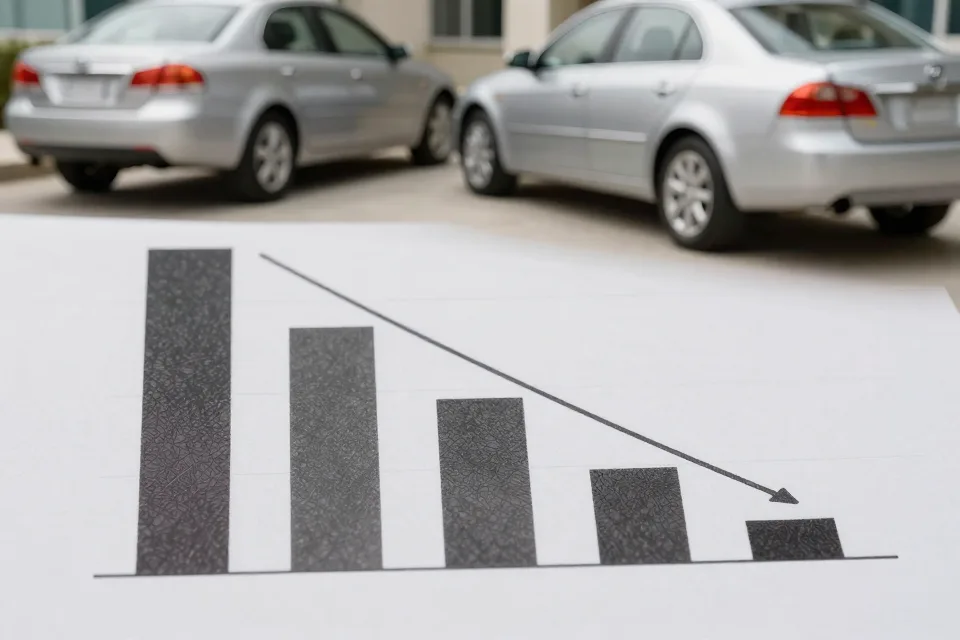
Why do the numbers differ? The studies use different data sets, different price bases (sticker price versus what buyers actually pay), and different market periods. Carfax's own guide adds another eye-opener: a typical car loses more than 10% of its value within the first month after it leaves the lot. For budgeting purposes, treat about half of the value gone in five years as the working rule, then adjust for the specific car.
Why the First Year Hurts the Most
Three forces pile up on a new car in its first twelve months. First, the title changes hands, and the car immediately trades in the new-car market, where the sticker includes dealer markup, delivery fees, and the premium people pay for a car nobody has owned. Second, the market floods with incentives on next year's models, which undercuts the price of a one-year-old car. Third, the warranty story changes: a car with a few thousand miles no longer carries the same factory-fresh protection in the eyes of a buyer.
That is why a two- or three-year-old car with a clean history can be such a bargain. Someone else has already absorbed the steepest part of the curve. Certified pre-owned programs lean on exactly this logic, pairing a used-car price with extended warranty coverage.
What Makes a Car Depreciate Faster or Slower?
The headline numbers hide a wide range. A few factors do most of the work:
-
Mileage. Carfax reports that driving about 7,500 miles a year instead of 15,000 can reduce depreciation by thousands of dollars over five years, because a used car's value rides largely on how many unused miles it has left.
-
Condition and accident history. Carfax finds an accident typically knocks just under $500 off a car's retail price, while severe damage costs an average of about $2,100. Clean titles and unblemished panels matter.
-
Brand reputation. Kelley Blue Book's projections show Toyota and Lexus as the two brands with the lowest five-year cost to own, a sign of the resale strength that comes from a proven reliability record.
-
Body style. Industry data cited by Progressive shows trucks and SUVs generally hold their value longer than sedans, while luxury sedans tend to drop the most.
-
Fuel type. Kelley Blue Book says electric vehicles typically take a steep 35% to 40% first-year hit before settling around 45% to 50% of their original value after five years. AAA's study likewise finds EVs carry the second-highest total ownership costs, driven mainly by depreciation, purchase price, and financing, even though their fuel and maintenance bills are the lowest.
-
Popularity. The same iSeeCars data cited by Progressive found the Porsche 911 lost just 9.3% of its value over five years, while the Maserati Quattroporte (64.5%) and BMW 7 Series (61.8%) lost the most.
Depreciation Is the Biggest Check You Never Write
AAA's Your Driving Costs study, based on five years of ownership at 15,000 miles a year, puts the total cost of owning and operating a new car at about $12,297 a year. Depreciation is the largest slice at roughly $4,680 annually, followed by finance charges averaging about $1,332 a year. The average sticker price of the cars in the study was about $38,883.
What makes depreciation sneaky is that no money changes hands while you own the car. The cost only becomes visible when the dealership hands you a trade-in offer, or when you sell privately and see the check. A $40,000 SUV that books at $16,000 after five years has quietly cost its owner $24,000 in value, on top of every gallon of gas and every oil change.
Leasing: Paying for Depreciation a Little at a Time
Leases make depreciation visible in a different way. According to the Federal Reserve, a lease payment covers the vehicle's expected loss in value during the lease term, plus a rent charge, taxes, and fees. The predicted value at the end of the lease is called the residual value, and it drives the payment: the higher the residual, the smaller the monthly bill, because you are financing less decline.
That is why leasing rewards cars that hold their value and punishes cars that do not. You are effectively paying for depreciation in monthly installments, and at the end you own nothing. If you are considering a lease, ask for the residual value and compare it with the car's projected market value after the term, so you know whether the payment is really as good as it looks.
Common Mistakes That Speed Up Depreciation
| Mistake | Why it costs you | Do this instead |
|---|---|---|
| Buying new when you drive little | You absorb the steepest loss for the least use | Consider a two- or three-year-old certified pre-owned car |
| Skipping maintenance and losing the paperwork | Service records are a buyer's best proof of care, and history reports count them | Follow the owner's manual and keep every receipt |
| Letting small dents and scratches fester | Damage history drags down retail value, especially after a real collision | Fix chips, dents, and scrapes early |
| Piling on miles | 15,000 miles a year instead of 7,500 can cost thousands at resale | Know your annual mileage and shop accordingly |
| Financing a fast-depreciating car for six or seven years | The loan balance can outpace the car's value | Choose shorter terms or a bigger down payment |
| Buying a used car without checking its history | Rolled-back odometers and hidden damage come back to bite you | Get a vehicle history report and an independent inspection |
Two of these deserve extra detail. On financing, Edmunds reports that the average amount owed on upside-down auto loans hit an all-time high at the end of 2024, and CNBC, citing Edmunds data, says close to one in three trade-ins is now underwater, meaning the owner owes more than the car is worth. A long loan on a fast-depreciating model is the classic way to end up there.
On history, the stakes are real. Odometer tampering is illegal, yet NHTSA warns it still happens, and recommends comparing the mileage on the title and service records with the odometer reading, checking the wear on the pedals and driver's seat, and reporting any suspected rollback. The FTC adds that dealers must display a Buyers Guide on every used car they sell, that the guide tells you whether the car comes with a warranty or is sold as is, and that you should get all promises in writing and have an independent mechanic inspect the car before you buy.
How to Slow Depreciation: A Plain-English Playbook
-
Buy the car's reputation, not just the discount. Strong-resale brands such as Toyota and Lexus, per Kelley Blue Book, keep more of their value year after year.
-
Skip the first-year plunge. A gently used or certified pre-owned car lets someone else eat the biggest loss.
-
Keep miles reasonable. It is the single most controllable factor on the list.
-
Maintain the car and document it. The Car Care Council notes that regular maintenance improves fuel efficiency and that oil changes are the best investment in engine longevity. Keeping tires properly inflated can improve gas mileage by 0.6% on average and up to 3%, according to fueleconomy.gov, and using the recommended motor oil grade adds 1% to 2%.
-
Mind the running costs, not just the sticker. fueleconomy.gov's hybrid comparison tool shows how many years of fuel savings it takes a hybrid to repay its higher price, a reminder that an efficient car saves money with every mile.
-
Keep the car long enough to spread the loss. The annual depreciation shrinks as the car ages, so the per-year cost of ownership falls the longer you hold it, before repairs eventually catch up.
-
Sell or trade before the big-repair years if you can. Once major components start failing, repair bills eat into whatever value remains.
Summary Checklist
-
The first year is the biggest loss, often 12% to 20% or more depending on the source.
-
Plan on roughly half the value gone after five years, then adjust for the model.
-
Choose models with strong resale records, and consider certified pre-owned.
-
Keep mileage in check and follow the maintenance schedule.
-
Keep service records and fix small damage before it grows.
-
Check a used car's title, history, and mileage before signing, and get the Buyers Guide explained.
-
Match the loan term to the car's value curve to avoid ending up underwater.
-
If leasing, understand the residual value, because you are paying for depreciation by the month.
Depreciation is not a trap. It is the price of the convenience and safety of driving a modern car, and it behaves predictably. Understand the curve, buy and hold accordingly, and the numbers work quietly in your favor. This article is general information for everyday drivers and is not financial, legal, or investment advice, and resale values vary by market and by individual car. See our full disclaimer.
Sources
- [authority] https://newsroom.aaa.com/2024/09/aaa-your-driving-costs-the-price-of-new-car-ownership-continues-to-climb/